
Iran War: We Follow The Money (To Mar-A-Lago)
How the Mar-A-Lago Gang is Cashing In On The Iran War

by The Democracy Defender
Here is a number to sit with: $2,000 per truckload.
That’s the fee a little-known Florida company called Gothams LLC — the same firm that ran the “Alligator Alcatraz” immigrant detention center — wants to charge for every single humanitarian aid truck entering a conflict zone under American control. Commercial trucks? $12,000 each. The contract they pitched to the White House demands a seven-year monopoly on all trucking and logistics, with a guaranteed 300% return on capital expenditure. Federal contracting experts called it “highway robbery.” The White House claimed the proposal was shelved. Records show Gothams partners were still coordinating with administration officials as recently as early 2026.
This is the Iran war.
Not the one you’re being told about — the one wrapped in flags and “national security” and solemn talk of nuclear threats. That war exists too, of course. But beneath it runs a parallel architecture, a financial machinery so brazen in its design that it makes the Iraq-era Halliburton contracts look quaint by comparison. In this war, every cabinet member has a financial stake. Every bomb dropped is a live-fire sales demo. Every barrel of Iranian crude pulled off the global market is a windfall for a politically connected fracking company in Texas. And when the rubble settles, the people carving up the reconstruction aren’t diplomats — they’re real estate billionaires pitching luxury hotels and artificial islands to sovereign wealth funds in Riyadh.
This isn’t a byproduct of the conflict. It is the conflict.
The Seeds of War
Approximately 70% of Trump’s cabinet and more than 50 government officials have direct prior roles with the Heritage Foundation or its Project 2025 partner groups. That is not a statistic that gets enough attention. The Heritage Foundation — through Project 2025 and the subsequent “Project 2026” — didn’t just publish a policy wish list. It built a personnel pipeline that placed hundreds of vetted loyalists into the federal bureaucracy, each one committed to a specific task: centralize executive power, dismantle regulatory oversight, and an “America First” foreign policy that treats military force as the default instrument of statecraft.
The Iran war is what that pipeline was built to produce. Discussions began with Colin Powell addressing Heritage in 2018 and actionable “maximum pressure” policy was drawn up in 2022-2023.
For decades, Heritage has advocated for the destruction of the Iran nuclear deal, for “maximum pressure” campaigns, and for the explicit position that the Iranian regime cannot be negotiated with — only confronted. Their scholars have called the current moment a “golden window of opportunity.” Their policy papers called for “sustained operations involving weeks of bombing.” Their Sentinel Action Fund — a Super PAC — lobbied for the exact defense appropriations now funding the carrier strike groups in the Persian Gulf.
This was not a reaction to events. It was a strategy waiting for the right President and the opportunity to execute it. And the personnel is now in place — not just ideologues, but billionaires with portfolios that rise and fall with every decision they make from inside the government.
Which brings us to the money.
The Pentagon as a Private Equity Portfolio: Stephen Feinberg
The Department of Defense now officially goes by a secondary title: the “Department of War.” The name change is telling, but the real transformation is structural in a financial sense.
At the center of it sits Stephen Feinberg, co-founder of Cerberus Capital Management — a private equity firm with approximately $70 billion dollars in assets — who serves as the Deputy Secretary of Defense. While Pete Hegseth plays the role of ideological figurehead, talking “warrior ethos” to the cameras, Feinberg is the one actually running the Pentagon’s $900 billion-plus budget. He manages it, according to observers, with the “terrifyingly intense scrutiny” of a corporate turnaround specialist. Which is exactly what he is.
Feinberg signed an ethics agreement to divest his Cerberus interests. Then he didn’t. He maintained financial ties to the firm through administrative service contracts for accounting and tax compliance — contracts he claimed were “impossible” to transition to an outside provider. That’s a convenient “impossibility” when your “former” firm’s portfolio is a direct beneficiary of the war you’re helping run.
Here’s what Cerberus owns:
TABLE 1
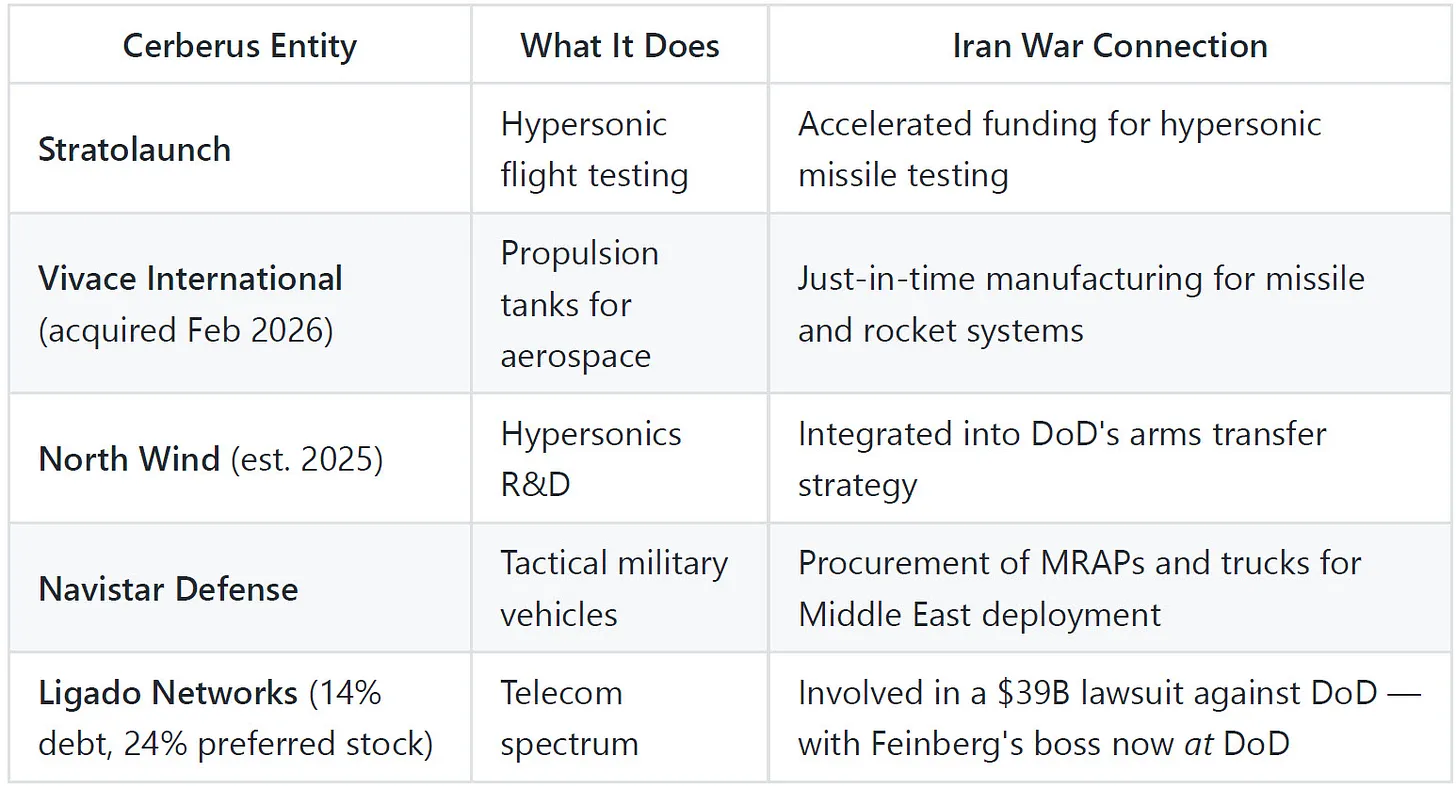
The 2026 National Defense Strategy calls for investment in “novel technologies” and “autonomous systems.” Cerberus Ventures — the firm’s venture capital arm — Just happens to have focused its investment strategy on exactly these areas. And Feinberg, from his perch at the Pentagon, has loosened contracting regulations to create a “fast track” for smaller firms — many with ties to Cerberus — to secure sole-source, noncompetitive contracts under the banner of “mission-based requirements.”
The June 2025 strikes on Iran’s Fordow nuclear facility weren’t just military operations. They were live-fire demonstrations for hypersonic weapons systems developed by private equity-backed firms. Every successful strike is a proof of concept. Every proof of concept drives up the portfolio value. And the man overseeing Pentagon procurement is financially connected to the firms doing the selling.
Feinberg has also advocated for “clever financing models” where private equity firms directly fund military infrastructure — data centers on military bases, for instance — creating long-term mechanisms for extracting rent from the defense budget itself. The Pentagon isn’t just buying weapons from private equity. Under Feinberg, it’s becoming a tenant that will be paying for decades to come!
The Commerce Secretary’s Insider Bet: Howard Lutnick
If the Feinberg story is about slow structural corruption, the Howard Lutnick story is about something faster and more breathtaking: a sitting cabinet member’s firm betting against his own policies — and winning.
Lutnick, the CEO of Cantor Fitzgerald, was confirmed as Commerce Secretary in February 2025. From that position, he oversaw the aggressive use of the International Emergency Economic Powers Act (IEEPA) to impose tariffs and sanctions — the “America First” trade war in its most weaponized form.
Meanwhile, his firm — now “run by his son”, Brandon Lutnick — was doing something extraordinary. Documents reviewed in July 2025, and a subsequent House Judiciary Committee investigation led by Rep. Jamie Raskin, revealed that Cantor Fitzgerald had been buying the rights to collect potential tariff refunds from American importers at 20 to 30 cents on the dollar.
Read that again. Lutnick’s firm was buying up the claims of businesses damaged by Lutnick’s own tariffs — at a massive discount — betting that the courts would eventually strike down those tariffs as illegal.
On February 20, 2026, the Supreme Court did exactly that.
The result: 300% to 500% profit for Lutnick’s Cantor Fitzgerald on every claim they purchased.
The incentive structure is almost too corrupt to believe:
- The Commerce Secretary imposes aggressive, potentially illegal tariffs that disrupt trade and damage American importers.
- The Secretary’s own firm buys the rights to eventual refunds from these same injured companies — at pennies on the dollar.
- When the courts strike down the tariffs — as the Secretary’s firm clearly anticipated — it collects the full refund value.
And the Iran war makes this worse, not better. The administration’s use of IEEPA to target “specified imports” and “perceived threats” related to the conflict creates a continuous stream of new distressed trade claims for Cantor Fitzgerald to scoop up. Every new sanction, every new emergency declaration, is a new batch of distressed companies for the Secretary’s family firm to profit from.
The Treasury Secretary’s Generational Windfall: Scott Bessent
Heritage Foundation backed Treasury Secretary Scott Bessent is a former protégé of George Soros who ran Key Square Group, a macro hedge fund that — by design — makes its money from geopolitical volatility. Macro funds don’t bet on individual stocks. They bet on the chaos itself: currency swings, commodity shocks, the ripple effects of sanctions and wars.
Now imagine that investor sitting inside the U.S. Treasury, with direct control over sanctions policy.
Bessent agreed to divest from 28 assets, including private equity funds and Bitcoin trusts. He failed to do so within the required 90-day window. Ethics complaints followed. The Campaign Legal Center and the Democracy Forward Foundation filed formal complaints alleging he was holding assets specifically to benefit from the volatility he was helping to create.
TABLE 2
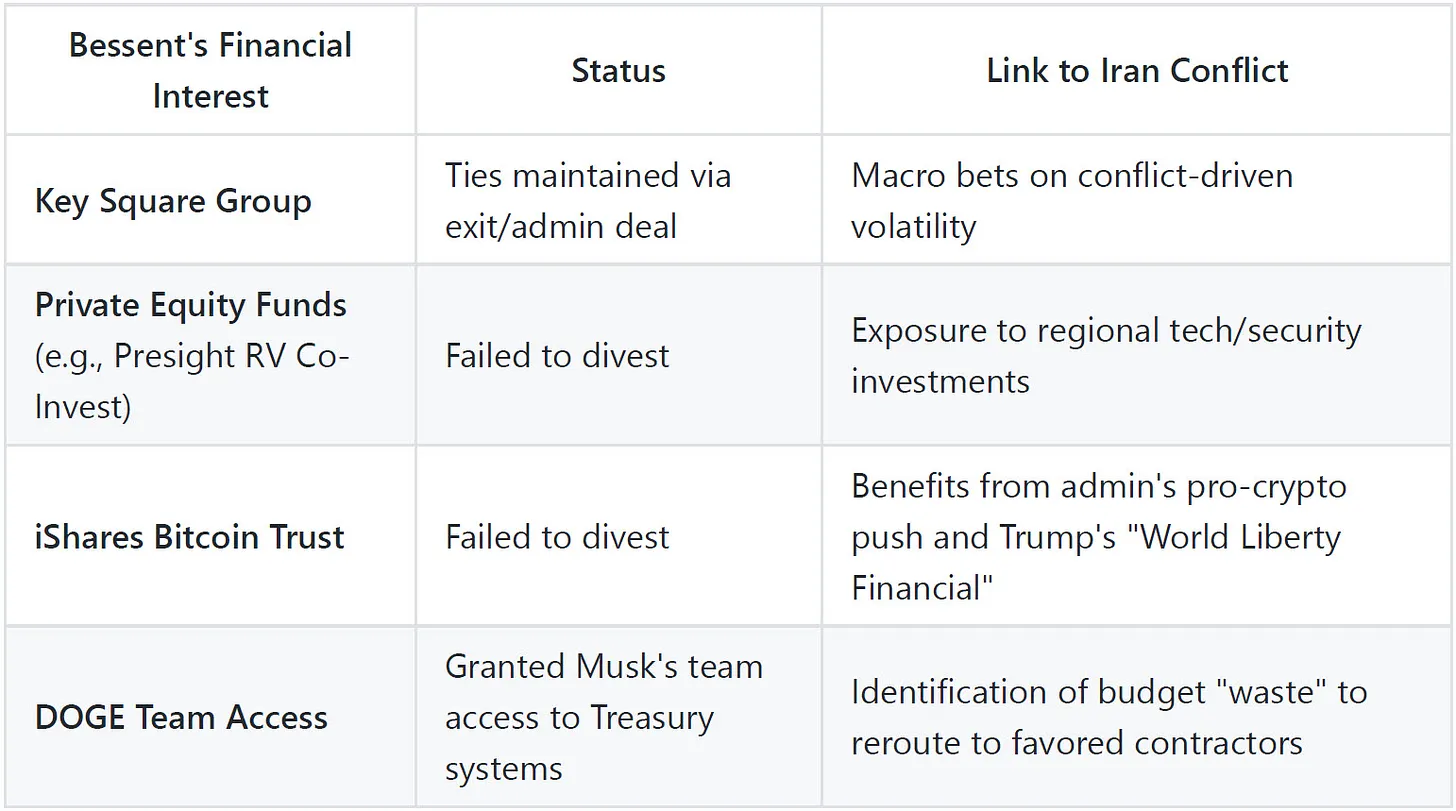
The Iran conflict is the ultimate macro engine. When Bessent’s Treasury Department sanctions individuals, entities, and vessels linked to the IRGC, those sanctions create massive swings in the Iranian rial, global oil futures, and the currencies of regional players like the UAE and Saudi Arabia. For a macro investor, this level of insider visibility into the timing and severity of sanctions is not merely advantageous. It is, as one analyst put it, a “generational windfall.”
Bessent controls when the disruptions happen. His former fund was built to profit from exactly these disruptions. And he never fully cut the cord.
Drill Baby Drill – For War: Energy Secretary Chris Wright
If the Pentagon is where the weapons profits flow, the Energy Department is where the commodity profits pool.
Heritage Foundation backed Secretary of Energy Chris Wright is the founder and former CEO of Liberty Energy, a fracking services company. His financial disclosures ran to over 1,800 pages. They revealed energy-related stock holdings in the “tens of millions of dollars,” including nearly 3 million shares of Liberty Energy held by Wright and his spouse. He agreed to reduce his holdings. The regulatory environment he personally oversees determines what those remaining holdings are worth.
The Iran war is the best thing that could have happened to domestic oil and gas producers, and Wright knows it. The administration’s “maximum economic pressure” campaign against Iran — sanctioning over 30 entities, targeting the Iranian “shadow fleet” — has pulled millions of barrels of crude off the global market. When you combine that artificial supply constraint with the ever-present threat of Iran closing the Strait of Hormuz (now closed, and through which roughly 20% of the world’s oil passes), the result is predictable: energy prices go up. American shale producers — the very industry Wright built his career in — rush to fill the gap.
This is Wright’s stated vision made manifest. He has publicly argued that hydrocarbons “still fuel roughly 85% of global energy supply” and has worked to dismantle climate-related reporting requirements. The war provides the geopolitical cover to accelerate that agenda: more drilling, more fracking, more production — all framed as “energy dominance” and “national security.”
Meanwhile, the oil and gas industry donated $25.8 million to Trump campaign groups in 2024 alone. The policy returns on that investment are now arriving in the form of executive orders that favor production, the dismantling of environmental regulations, and a Middle Eastern conflict that has driven up the price of the very commodity they sell.
The Board of Profits: When Bombs Become Business Plans
This is where the story reaches its most audacious chapter.
The Board of Peace — chaired by Donald Trump in his personal capacity — oversees a $17 billion “Gaza Reconstruction and Development Fund” and is positioned to manage similar initiatives for most other conflict zones, including a post-regime-change Iran. The Board’s members are not diplomats, aid workers, or regional experts. They are real estate moguls and private equity titans from Trump’s inner circle.
TABLE 3
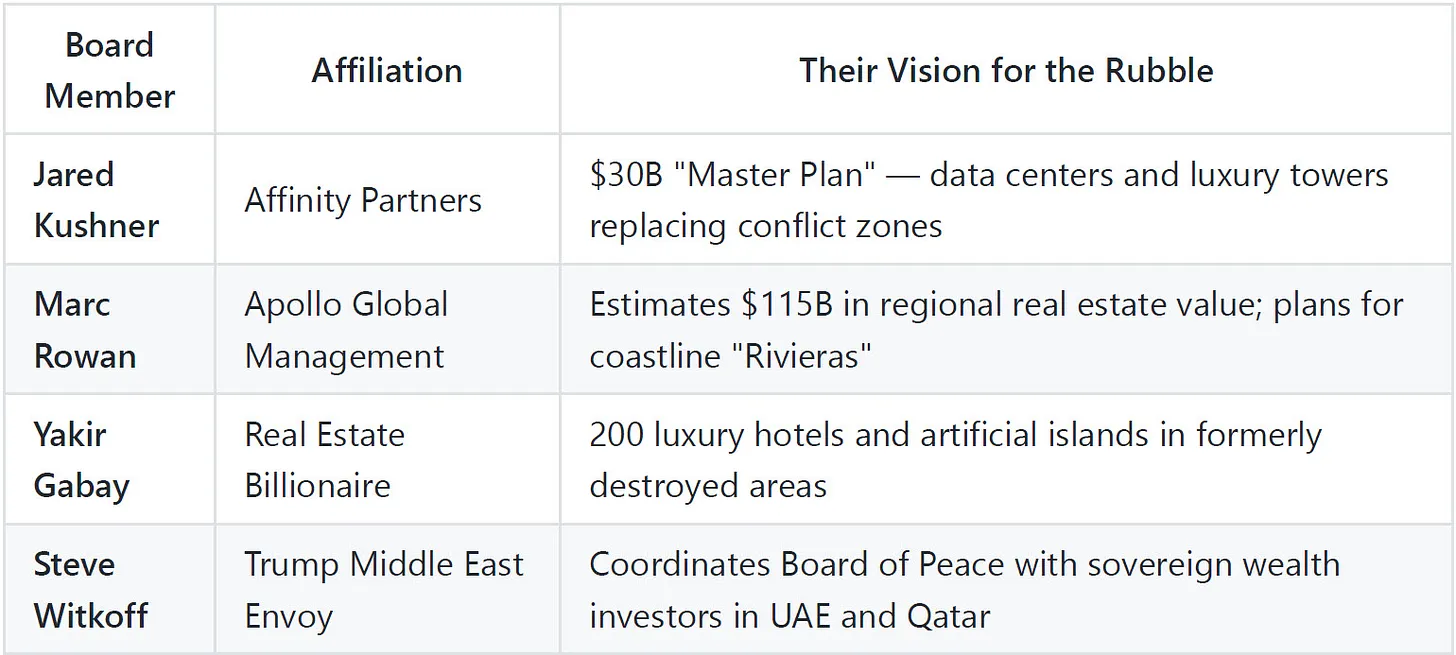
At the center of this apparatus is Jared Kushner, whos Abraham Accords Peace Institute (AAPI), has now merged into The Heritage Foundation (See a pattern here?) whose private equity firm, Affinity Partners, raised $2 billion from the Saudi Public Investment Fund almost immediately after he left the White House in 2021. That investment was subject to a Congressional probe. Critics described it as “legalized bribery” — a payoff for Kushner’s support of Saudi interests during the first Trump term, including his handling of the Khashoggi murder and his backing of the Yemen war.
SO the financial mechanics are locked in regardless of the outcomes. On the 2 billion Saudi investment, Kushner personally collects **25 million dollars annually in management fees** — whether the fund ever makes a cent of profit or not. Affinity Partners has since expanded its role, reportedly commandeering a position in the Saudi acquisition of American corporate assets like Electronic Arts (EA Sports), providing “political cover” and “regulatory protection” for Saudi capital flowing into the U.S.
Now apply this model to Iran. As American bombs destroy Iranian infrastructure, Kushner and the Board of Peace are already shopping “amazing investment opportunities” in a “post-regime Iran” to sovereign wealth funds in Riyadh and Abu Dhabi. Board Of Profits indeed. Marc Rowan of Apollo Global Management estimates $115 billion in real estate development potential. Billionaire and insiderYakir Gabay is already proposing 200 luxury hotels and artificial islands — built on the rubble of what American and Israeli strikes have just flattened… With your tax dollars.
The obscenity of this arrangement is hard to overstate. The same political network that pushed for the war is now positioned to profit from the reconstruction. The President chairs the board — in his personal capacity — that will allocate the contracts. His son-in-law runs the fund. And the “customers” are the Gulf monarchies whose money flows through all of it.
Editors Note: World Liberty Financial (WLF), a venture backed by the Trump family, earns revenue by investing the dollars that back Trump’s USD1 Stablecoin into safe assets like U.S. Treasuries. The Board Of Peace is planning to mandate use of USD1 for all their post warfare rebuilding such as Gaza and Iran..
Revenue Share: Trump entities (specifically DT Marks DEFI LLC) are entitled to approximately 75% of the interest generated from World Liberty Financial holdings. Recent reports estimate this could generate over $136 million in profit for the Trump family based on current circulation.
Translation: The Trump family will profit directly from every dollar invested in rebuilding that will go through the Board Of Peace. More destruction = more profit.
The Shadow Contractors: Then There’s the Kickbacks –
Below the billionaire class, a secondary economy of politically connected contractors is thriving.
Gothams LLC — the “Alligator Alcatraz” firm mentioned at the top of this article — has emerged as the leading candidate for the role of “Master Contractor” across the Middle East. Their draft proposal, obtained in late 2025, laid out a “Gaza Supply System Logistics Architecture” that federal experts called one of the most extractive contracting arrangements they had ever seen:
- 300% guaranteed return on capital expenditure
- Seven-year monopoly over all trucking and logistics
- $2,000 fee per humanitarian truckload; $12,000 per commercial truck
This model — where a politically appointed “Board of Peace” serves as the customer, guaranteeing triple returns to preferred contractors — is expected to be the template for post-conflict operations in Iran.
Then there’s UG Solutions, a private military company incorporated in 2023 by Special Forces veterans Jameson Govoni and Glenn Devitt — both vocal Trump supporters. UG Solutions operates checkpoints in conflict zones, providing what experts describe as a “layer of separation and deniability” for the administration. Small PMSCs like this function as corporate shells for off-the-books payments and arms transfers, allowing the executive branch to circumvent Congressional oversight entirely.
These aren’t aberrations. They are the system working as designed. The old military-industrial complex at least operated through large, publicly traded defense contractors subject to some degree of scrutiny. The new model runs through shell companies, sole-source contracts, and a Board of Peace that answers to no one except the President — who chairs it as a private citizen while simultaneously serving as Commander-in-Chief.
The Golden Grift: When the Government Becomes the Hedge Fund
In perhaps the most radical departure from the free-market ideology this administration claims to champion, the White House has begun taking direct equity stakes in public companies.
On January 7, 2026, Trump signed an Executive Order authorizing the “Secretary of War” to identify underperforming defense contractors, ban them from stock buybacks, and potentially impose a “golden share” — a forced equity stake giving the government direct control over a company’s production priorities.
TABLE 4
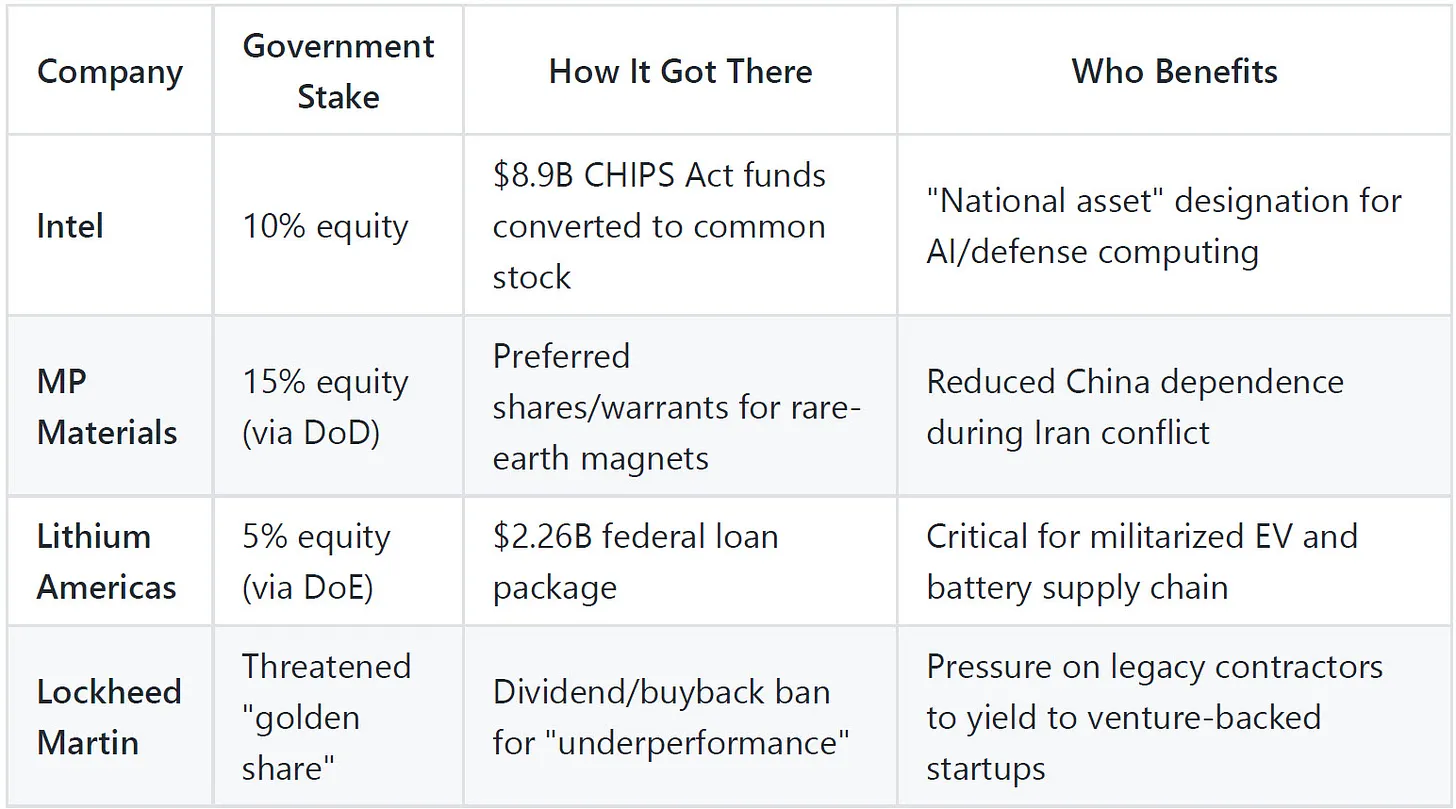
This creates what can only be described as a state-sponsored investment club. Donors from the securities and investment industry gave $193.8 million to Trump groups in 2024. They can now invest in companies “tied directly to U.S. industrial policy” — companies whose valuations are backstopped by the federal government itself. For hedge fund billionaires like Paul Singer, Nelson Peltz, and Diane Hendricks, the Iran war provides the justification for the state to “lock in” domestic production, ensuring their investments in fossil fuels, manufacturing, and mining are protected by the full force of American military power.
The government is no longer just the customer for these industries. It is the co-investor, the regulator, and the guarantor of returns — all at once. And Donald Trump reaps the kickbacks as “campaign donations”.
The Integrated Conflict Economy
Let’s step back and look at the full picture.
This is not a war with some corruption around the edges. It is a financial architecture disguised as foreign policy. Every layer of the conflict — from the decision to strike, to the weapons used, to the sanctions imposed, to the energy markets disrupted, to the reconstruction that follows — has been engineered to produce returns for a specific, identifiable group of people: “The Mar-A-Lago Gang”
At the cabinet level: Feinberg steers Pentagon contracts toward his own investment orbit. Wright profits from energy prices driven up by the very conflict his administration created. Lutnick’s firm bets against his own tariffs and wins. Bessent sits on undivested assets while controlling the sanctions that move markets.
At the advisory level: Kushner and the Board of Peace are already selling post-war Iran to Gulf monarchies — pocketing $25 million a year in management fees before a single building rises from the rubble.
At the contractor level: Shell companies with political connections extract 300% guaranteed returns on humanitarian logistics, while private military firms operate checkpoints with no Congressional oversight.
At the donor level: A “vetted” class of billionaire investors puts money into companies that the government has effectively guaranteed — companies whose stock prices are backstopped by executive orders and war.
This is what a “Mercenary State” looks like. War is not a policy failure or a last resort. It is a business model — the highest-margin venture in the portfolio of the people who run the country.
The bombs fall on Tehran. The profits land in Mar-a-Lago.
And the people paying the price — American soldiers, Iranian civilians, taxpayers funding $900 billion defense budgets — pay for it all.
In our next article, we will examine how this war was intellectually engineered over the last decade — tracing the role of the Heritage Foundation, the Atlas Network, and the International Democracy Union in building their ideological and administrative framework that made the 2026 Iran conflict not just possible, but inevitable.
Sources
- Closing the Regulatory Gap in Trump’s Middle East Strategy — The Washington Institute
- The Trump Administration’s Middle East Policy: Shaping an Emerging Regional Order — CSIS
- Trump Taps Private Equity to Shape the Pentagon’s Future — CEPR
- Here Are Trump’s Investment Industry Donors — Sludge
- Trump deliberated on Iran for weeks — KESQ/CNN
- Board of Peace will be a bonanza for wealthy board members — Responsible Statecraft
- US contractor sent Gaza plan to White House that would secure 300% profits — The Guardian
- Stephen Feinberg wins Senate confirmation — DefenseScoop
- Fact Sheet: President Trump Prioritizes the Warfighter in Defense Contracting — The White House
- Cerberus Co-Founder Confirmed as Deputy Secretary of Defense — Cerberus Capital Management
- The 2026 National Defense Strategy by the Numbers — CSIS
- It’s PE vs. VC in the scramble to remake America’s way of war — Semafor
- Senators ignore that this billionaire is a walking conflict of interest — Responsible Statecraft
- Deputy Defense Secretary Nominee Talks DOD Audit — Department of War
- Media Center — Cerberus Capital Management — Cerberus
- Stephen Feinberg Ethics Agreement — Office of Government Ethics
- Epstein Files Show Financial Ties to DOD Deputy Secretary Feinberg — POGO
- Jared Kushner’s Great EA Swindle — CEPR
- Deputy defense secretary nominee has ‘clear conflict of interest’ with Ligado lawsuit — Breaking Defense
- Trump’s 2025 Executive Orders — Holland & Knight
- Chris Wright Ethics Memo — The White House — White House
- The Doublespeak of Energy Secretary Chris Wright — ProPublica
- Chris Wright’s Testimony on the SEC Climate Rule — U.S. House of Representatives
- Washington — Iran Trigger List — International Crisis Group
- Treasury Targets Iran’s Shadow Fleet — U.S. Treasury
- 2026 kicks off with a carrier and tariff big bang — Scan Global Logistics
- The White House is Now a Hedge Fund — Legacy Grain Cooperative
- Wright financial documents detail fossil fuel and mining holdings — Politico Pro
- Billionaire Nominee for Deputy Defense Secretary Grilled — Military.com
- Details emerge on Wright’s stock holdings, DOE firings — Politico Pro
- Money in Politics Roundup — February 2026 — Brennan Center for Justice
- Adjusting Imports of Processed Critical Minerals — The White House
- Second Cabinet of Donald Trump — Wikipedia
- Rep. Raskin letter to Howard & Brandon Lutnick re: Tariff Arbitrage — House Judiciary Committee Democrats
- Congressional Investigations to Take Center Stage in 2026 — Pillsbury Law
- Political appointments of the second Trump administration — Wikipedia
- Cantor Fitzgerald Schedule 13D/A Filing — SEC
- Scott Bessent — Wikipedia
- Ethics Complaint: Bessent Divestiture Failures — Campaign Legal Center
- The $2 Billion Bet: How Jared Kushner Secured the Largest Sovereign Wealth Investment — Global Times Singapore
- Affinity Partners — Under the Microscope — FindingTruth
- U.S. Firm Seeks 300% Profits from Monopoly Over Gaza Trucking — Democracy Now
- Chairwoman Maloney Launches Probe of Saudi $2B Investment in Kushner’s Firm — House Oversight Committee
- Saudi Arabia and Kushner Join Forces in Historic Buyout of Electronic Arts — NYU Stern Center for Business and Human Rights
- ‘They’re trying to get rich off it’: US contractors vie to rebuild Gaza — The Guardian
- US Contractor’s Proposal Exposes Trump Gaza Plan as ‘Vehicle for Mass Exploitation’ — Common Dreams
- In Gaza, Trump Embraces Private Military Contractors — Inkstick
- Trump’s Turn Toward Power Politics and the European Defense Sector — Funds Society
- Private Equity Firms Tighten Stranglehold on US, Angling for Boons Under Trump — Truthout
____
https://thedemocracydefender.substack.com/p/iran-war-we-follow-the-money-to-mar