

President Donald Trump told commercial ships waiting near the Strait of Hormuz to “show some guts.”
The comment came during a Sunday interview with Fox & Friends co-host Brian Kilmeade in which the president insisted Iran’s military had been effectively neutralized by recent U.S. strikes. Tehran, he said, no longer had the capacity to threaten maritime traffic through one of the most important oil chokepoints on the planet. There was little to fear. Tankers could move.
That framing collided almost immediately with events on the water.
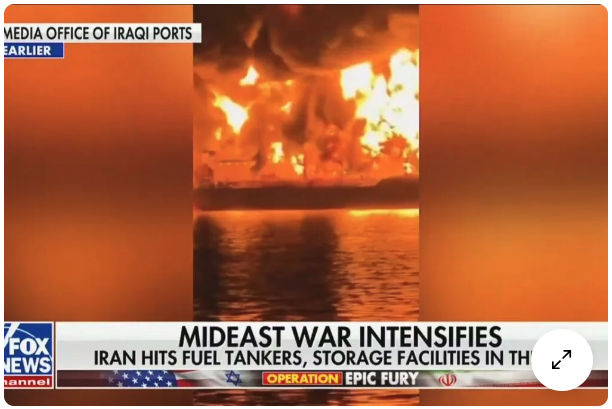
Within days, at least two commercial vessels were struck in Gulf waters. Two oil tankers burned after attacks near Iraq’s port of Basra, with at least one crew member killed. Other ships reported projectiles or drone strikes in nearby waters. Energy markets reacted predictably. Oil prices surged back above $100 a barrel as traders recalculated the risks attached to the Strait of Hormuz, a narrow corridor through which a substantial portion of the world’s crude supply moves each day.
Shipping companies and insurers tend to approach such situations with less rhetorical flourish than politicians. Tanker operators do not rely on presidential assurances when deciding whether to send multi-million-dollar vessels through a potential combat zone. They watch insurance premiums, maritime threat advisories, naval escort capacity, and satellite intelligence. When ships begin burning in a strategic waterway, the calculus changes fast.
Even a handful of successful attacks can ripple through the global economy. The Strait of Hormuz does not need to be fully closed to create disruption. The mere possibility that ships could be struck forces insurers to price the risk accordingly, and the cost of moving oil rises with it.
None of this alters a basic strategic reality. The United States military remains overwhelmingly more powerful than Iran’s conventional forces — the gap resembles the 96 Chicago Bulls facing a private school’s JV squad. American naval and air power can dismantle ports, destroy missile batteries, and eliminate surface vessels with extraordinary efficiency, which appears to be the case. The outcome of a direct confrontation has rarely been in doubt among military analysts.
The much more difficult question is what follows that dominance. Airstrikes can degrade military capability and cripple infrastructure, but they rarely dissolve political systems. If Iran’s leadership survives the opening blows — and early indications suggest it largely has — the regime remains the central actor in whatever comes next. Mojtaba Khamenei now occupies the same office his father held, and the Islamic Republic hasn’t vanished simply because its military took a heavy blow.
That’s the distinction that matters here. Degrading or eliminating Iran’s nuclear program is a legitimate and significant objective — one that many serious analysts across ideological lines have long considered necessary. But achieving it doesn’t produce regime change, and it doesn’t remove Iran’s ability to impose costs through asymmetric tactics.
Iran has spent decades preparing for exactly that environment. Its military doctrine doesn’t depend on defeating the United States in a conventional fight. It depends on creating instability in places that matter economically: oil infrastructure, maritime routes, proxy conflicts, missile harassment that raises the price of normal commerce. The strategy isn’t about winning in a traditional sense. It’s about ensuring that even a weakened Iran can make life uncomfortable for its adversaries.
Viewed through that lens, the tanker attacks take on a clearer meaning. Trump’s comments about ships showing courage weren’t really aimed at tanker captains waiting in the Gulf. They were a signal intended for Tehran and for global markets: Iran had been crippled, the waterway was open, the United States controlled the strategic environment.
The explosions that followed were a response of their own.
Both sides are operating within the same logic. Trump needs Iran to appear defeated. Markets stabilize, the intervention looks decisive, and the political case for the operation strengthens. Iran needs to appear undefeated. Its deterrence survives, its regional proxies remain confident, and its leverage endures. Neither side can afford to let the other’s narrative settle uncontested. The fight is not only over shipping lanes but over the perception of who controls them.
Trump’s instinct to project confidence in moments like this is understandable. Markets respond to signals from Washington, and political leaders routinely try to reassure them that trade routes are secure. But confidence that drifts into bravado can obscure a more complicated reality — conflicts almost never end as cleanly as early declarations insist.
In modern conflict, statements delivered on television and signals sent through explosions often travel along the same strategic channel.
____
https://www.yahoo.com/news/articles/trump-told-tankers-show-guts-133720181.html