
Seyed Marandi warns residents of Gulf states to ‘leave immediately’
Al Mayadeen English
Tensions rise as Tehran University professor Seyed Mohammad Marandi warns Gulf states and maritime traffic amid uncertainty over US-Iran ceasefire talks and possible escalation.
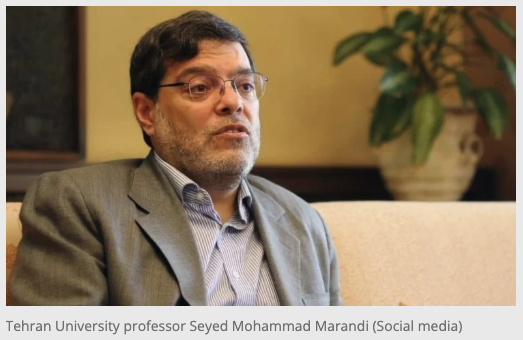
As the ceasefire window between the United States and Iran nears its end, uncertainty persists over the next phase of diplomacy, with Washington issuing sharper threats and Tehran yet to confirm participation in a potential second round of negotiations.
Against this backdrop, Tehran University professor Seyed Mohammad Marandi issued a stark warning directed at several Gulf countries. In a post on X, he urged residents in the United Arab Emirates, Qatar, Bahrain, Saudi Arabia, and Kuwait to “immediately leave” those states.
He also advised seafarers operating in the Gulf to prepare to evacuate their vessels, specifically highlighting ships near the Strait of Hormuz, which he stressed would be among the first targets in the event of escalation.
“This is especially urgent for ships near the Strait of Hormuz, which will be destroyed first,” he said.
“Time is running out,” Seyed Marandi wrote, emphasizing the urgency of his message.
It is worth noting that Iran has repeatedly said that US military bases and economic assets in the Gulf region have been used to launch acts of aggression against Iran, including strikes that have resulted in civilian casualties. In this framing, any Iranian action targeting such facilities is a retaliation against hostile military activity originating from or enabled by those bases.
Pakistan still awaiting response from Tehran on participation in talks
Iran has yet to formally confirm whether it will send a delegation to the upcoming peace talks in Islamabad, as a ceasefire deadline approaches, Pakistan’s Federal Minister for Information & Broadcasting Attaullah Tarar said on Tuesday.
In a statement on X posted at 19:30 Pakistan Standard Time (PST), Tarar said Islamabad was still awaiting an official response from Tehran regarding participation in the proposed “Islamabad Peace Talks.”
He added that Pakistan, acting as a mediator, remained in continuous contact with Iranian officials and was actively pursuing a diplomatic resolution through dialogue.
According to the minister, the current ceasefire is set to expire at 04:50 am PST on April 22, and he stressed that Iran’s decision on whether to attend the talks before the end of the two-week truce period is “critical”.
Tarar further said Pakistan had made “sincere efforts” to persuade the Iranian leadership to take part in the second round of negotiations and that these efforts were ongoing.
Pakistan urges an extension to the two-week truce
Pakistan has urged Washington and Tehran to extend their fragile ceasefire and deepen diplomatic engagement, according to a statement from the Foreign Ministry on Tuesday.
Islamabad called on both the United States and Iran to prolong the two-week truce and avoid a renewed escalation, stressing the importance of maintaining stability through dialogue.
In a separate meeting with acting US chargé d’affaires in Pakistan, Natalie A. Baker, Foreign Minister Ishaq Dar underscored the need for sustained communication between Washington and Tehran as tensions remain high.
Earlier today, US President Donald Trump said he believes the United States will ultimately secure “a great deal” with Iran aimed at ending the weeks-long war, even as he cast doubt on extending a ceasefire set to expire on Wednesday.
The comments came alongside renewed threats of additional strikes as diplomatic efforts continue.