
The Miracle of Walking: What Every Step Does for Your Brain
Sayer Ji

From Alzheimer’s to Parkinson’s, the human studies show that the simplest movement we have may be one of the most protective things we can do for the aging brain
🧵Read and share the X thread dedicated to this article.
The Headline Findings
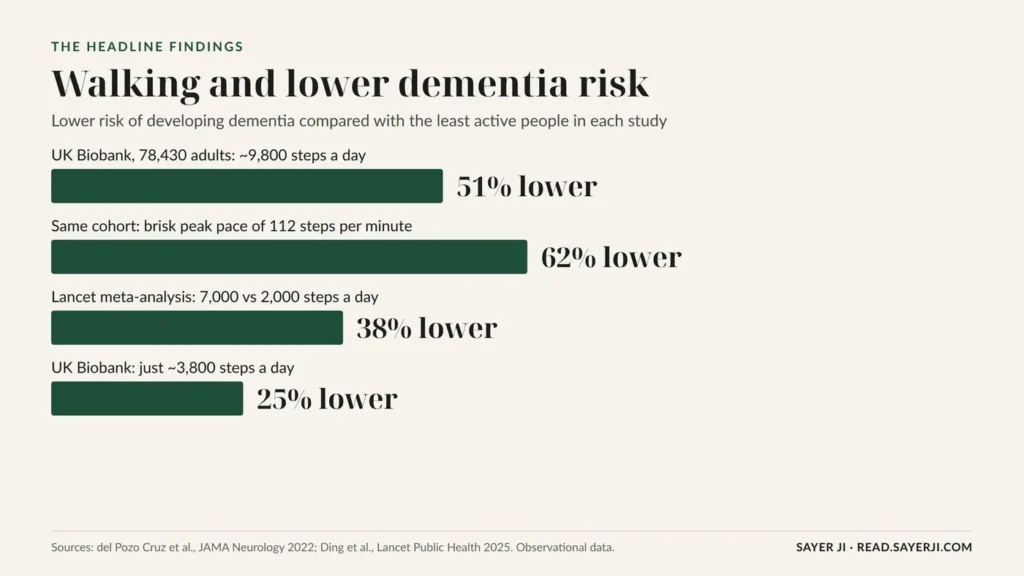
- 51% lower dementia risk at about 9,800 steps a day, in a study of 78,430 UK adults followed for nearly seven years. Even about 3,800 steps a day was linked to 25% lower risk. (JAMA Neurology, 2022)
- Pace matters too. People whose best 30 minutes of the day averaged 112 steps per minute, a brisk walk, had 62% lower risk. (JAMA Neurology, 2022)
- Years of clear thinking, even with Alzheimer’s changes already present. In older adults whose brain scans already showed amyloid, those walking 5,001 to 7,500 steps a day were estimated to reach cognitive impairment after 13.6 years, versus 6.5 years for the inactive, with slower buildup of the tau protein that tracks with memory loss. (Nature Medicine, 2025)
- Walking grew the brain’s memory center. In a randomized trial, one year of walking 40 minutes, three days a week, enlarged the hippocampus by 2%, roughly reversing one to two years of age-related shrinkage. (PNAS, 2011)
- 38% lower dementia risk at 7,000 steps a day versus 2,000, in the largest step-count meta-analysis to date. (Lancet Public Health, 2025)
- Parkinson’s symptoms held back. In two randomized trials, treadmill walking kept motor symptoms nearly flat over six months, and a brisk-walking program cut motor scores by 6 points versus 1.4 in controls. (JAMA Neurology, 2018; Journal of Parkinson’s Disease, 2021)
Over the past year I have written about walking from two directions. First came the soleus, the deep calf muscle I called the second heart you never knew you had, which pumps blood back toward the heart every time we take a step. Then came the step-count research showing that about 7,000 steps a day was linked to 47% lower risk of death. That second-heart piece has become my most-read article by a wide margin.
This piece asks a narrower and, for many families, more urgent question: what does walking do for the brain as it ages? What does it do for Alzheimer’s disease, other dementias and Parkinson’s disease, the conditions people fear most as they get older?
The answer from the human studies is remarkable. It is also more honest than most headlines allow. Some of the strongest numbers come from observational studies, and a few large trials came up empty. I will show you both.
The Step Count That Changed the Dementia Conversation
In 2022, researchers in Australia and Denmark analyzed wrist-worn activity trackers from 78,430 adults in the UK Biobank, aged 40 to 79. They followed them for a median of 6.9 years and counted who developed dementia. The result, published in JAMA Neurology, was a clean dose-response curve. The more people walked, the lower their risk, up to just under 10,000 steps a day.
Two details stand out. First, the benefit starts early: about 3,800 steps a day, a level many sedentary people can reach, was already linked to a 25% lower risk. Second, intensity mattered on top of volume. People whose best 30 minutes of walking averaged 112 steps per minute had the lowest risk of all.
THE TECHNICAL RECORD
UK Biobank prospective cohort, 78,430 adults with valid wrist accelerometer data, median follow-up 6.9 years, 866 incident dementia cases. Optimal dose 9,826 steps per day (HR 0.49; 95% CI 0.39-0.62). Minimal dose 3,826 steps (HR 0.75; 0.67-0.83). Purposeful steps (40 or more per minute) optimal dose 6,315 (HR 0.43; 0.32-0.58). Peak 30-minute cadence of 112 steps per minute (HR 0.38; 0.24-0.60). Observational: it shows association, not proof of cause. A published correction concerned only the open-access status. (del Pozo Cruz et al., JAMA Neurology 2022)