
…all the whales know it and are all
in on the long planned controlled
demolition of the Global Economic & Financial System

SOTN Editor’s Note: Here it comes, folks!!! And the volumes of both hard and circumstantial evidence strewn all across cyberspace conclusively proves that this “AI MEGA BUBBLE” was deliberately created and artificially inflated to the absolute insane maximum in order for the Financial Masters of the Universe (FMOTU) to execute their long planned controlled demolition of the Global Economic & Financial System. End of story.
This Alt Media platform has been predicting such a cataclysmic event (who hasn’t) since the controlled demo of 2008 that began with the real estate collapse of 2007. See: INSTRUCTIVE FLASHBACK: The Pre-Planned Financial and Economic 9/11 of 2008
Of course, that “Pre-Planned” 2008 collapse was merely the dress rehearsal for today’s final “Controlled Demolition” of the Global Gambling Casino as spelled out here: Epochal Transformation Accelerates as Global Financial Matrix Disintegrates.
Now bear in mind that this exposé was written well before the AI MEGA BUBBLE was fabricated to interpenetrate all of the other bubbles described here: The FOUR HORSEMEN OF THE FINANCIAL APOCALYPSE Herald the Death Knell of Predatory Capitalism & Kleptocratic Communism. Once the sufficient level of deep interpenetration is complete, the BIGGEST bubble of all time will be popped.
Bottom Line: We have now reached mathematical certainty because the FMOTU have financially engineered and fastidiously timed the upcoming sequence of shock and awe events to unfold with exacting purpose and awesome effect. And the purposefully staged psyop delineated below play a vital part in this meticulously orchestrated and calamitously choreographed Khazarian production.
State of the Nation
October 13, 2026
Hock Tan Warns AI Investors Are Gambling In A Casino… Whose Chips His Own Credit Is Paying For
ZeroHedge.com
Usually it’s the chip CEOs who are the cheerleaders and the bond market that plays the skeptic. On Monday, the CEO of the second-most important AI chipmaker on the planet decided to play both roles.
Speaking on a panel at a DBS conference in Singapore, Broadcom boss Hock Tan said that many of the investors piling into AI behave more like gamblers than investors, setting extreme expectations only to discover they are effectively sitting at a casino table. In his own words, “a lot of investors have no clue what they are investing in.”
He didn’t stop there. Tan also questioned the long-term economics of the money-losing frontier labs, and, most importantly for markets, warned that insufficient capital could become the next constraint on the AI industry’s growth. As if to make his point for him, Intel’s Lip-Bu Tan, who shared the panel, said hardware will stay in short supply for another two to three years. Translation: the chips will be scarce, and so will the money to pay for them.
Semis did not take it well. The SOXX slumped 2.6% and JPMorgan’s AI memory basket tumbled 4.3% on a day when more than 60% of S&P members actually rose. Asked to explain the selling, JPMorgan tech specialist Joshua Meyers wrote in the bank’s afternoon Market Intel briefing (available to pro subs) that “the most proximate reason seems to be Hock Tan’s participation in a panel at a DBS conference in Singapore, where he warned financing could become a bigger bottleneck than component shortages (in addition to questioning frontier lab business models, and comparing ‘many investors’ to casino gamblers).”
Below we look at why Tan is right about the bottleneck, and why the people he called gamblers are the ones keeping his stock afloat while his own bondholders head for the exits.
The Bottleneck Is Money
Tan’s warning will come as no surprise to (even not so regular) readers: we have been warning since last October that the AI buildout runs on ever increasing amounts of debt, and last week Goldman’s Rich Privorotsky effectively conceded the point when he said the AI borrowing binge is now crowding out everyone else in the capital markets.
The evidence has been piling up. Last Thursday, Nvidia-backed Australian data center operator Firmus first slashed the price of its IPO by 25% and then pulled its $5.5 billion listing altogether, opting to raise money in private markets instead (good luck with finding someone dumb enough there). Our reaction at the time:
And Tan wasn’t the only one at the DBS event flagging it: just before he took the stage, DBS CEO Tan Su Shan said the market is now repricing the risks around AI financing after the heavy investment of the past two years. When the bank hosting the conference and the chipmaker on the panel agree that the money is the problem, it’s probably the money.
The Customer Is Losing Money… And Broadcom Is Lending It
Then there is the swipe at the frontier labs. Tan said OpenAI’s $50 billion annualized revenue as of September suggests there is a viable business, but that the company is still losing money because it spends so much on training and compute, so for now the number tells you little about long-term profitability.
Fair enough. Except that OpenAI is Broadcom’s customer, and on top of it, courtesy of SPV structures that would make Jeff Skilling blush, Broadcom is the one arranging the money for OpenAI to buy Broadcom’s chips (you may get a little nauseous after reading that).

As we detailed last Thursday, Broadcom is in talks on a $50 billion+ chip financing for OpenAI (Bloomberg puts the next leg at closer to $30 billion), on top of the $60 billion it is syndicating for Anthropic and the $35 billion “Big Sky” platform it set up with Apollo and Blackstone in June. That’s roughly $145 billion of chip debt with Broadcom’s name on it, or as we put it when we tweeted this chart, “$300BN in chip-collateralized SPVs, so far”:
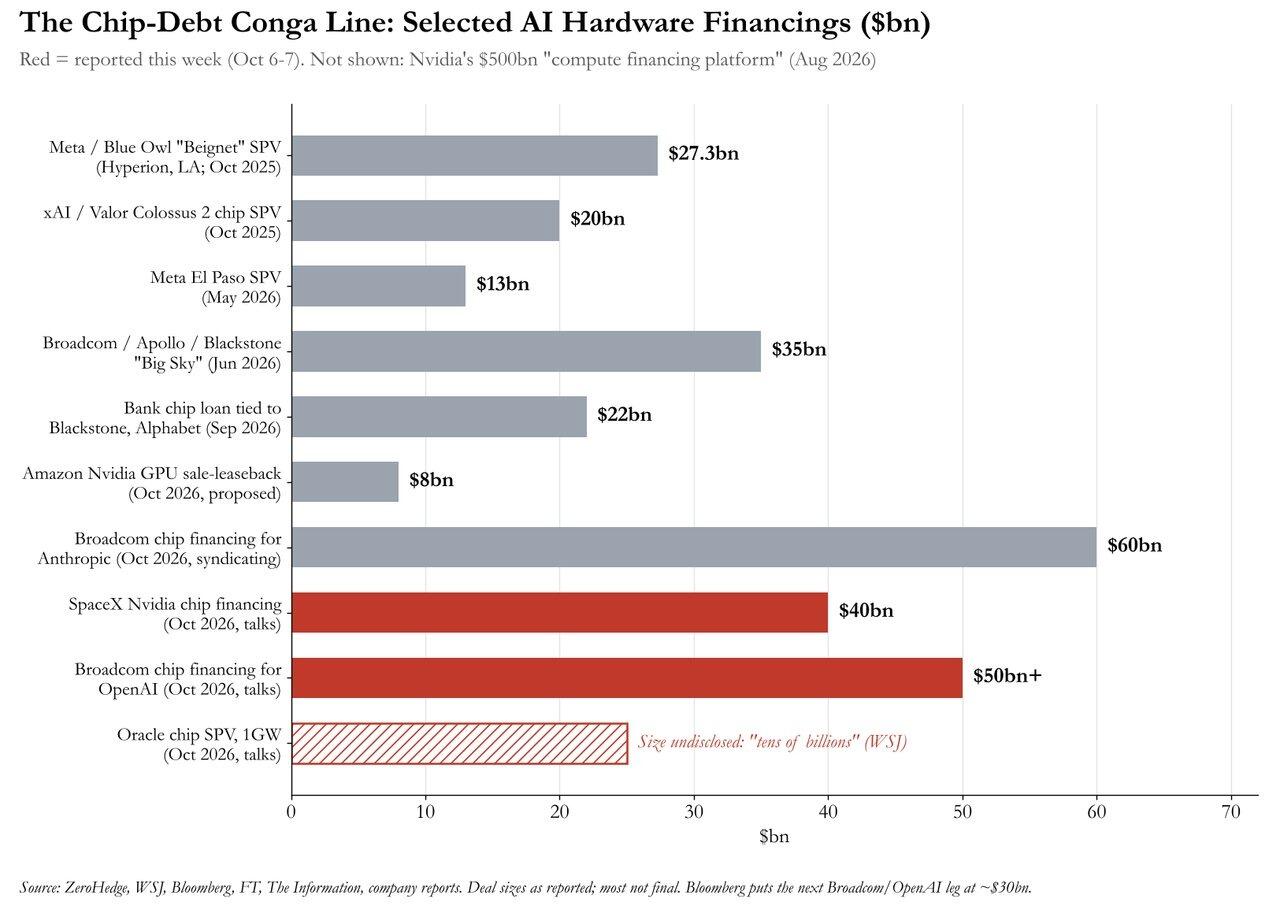
In other words, the CEO questioning the labs’ business models is also the biggest single lender to those business models! Over the weekend, Jefferies went even further, warning of “massive capital destruction” since just two cash-burning labs account for half of a $2.3 trillion backlog.

And last week’s FT report that OpenAI’s run-rate was ~$50 billion rather than the widely cited ~$70 billion, which Goldman‘s TMT desk chalked up to gross-vs-net accounting, showed just how much of a ~$1 trillion equity complex rests on largely made up and unaudited numbers from two private companies.
Gamblers Hold The Stock, Bondholders Hold The Bag
Which brings us to the irony. Tan may sneer at the “casino” crowd, but the casino is the only thing propping up AVGO. Per Goldman’s derivatives desk, Mag7 is now ~22% of total US prime exposure (the most since early 2022), semis exposure has doubled to ~12% from ~6% at the start of the year, and roughly $115 billion sits in levered semis ETFs. JPMorgan’s factor team adds that semiconductor sentiment is back above the 99th percentile. Those are the real gamblers.

Broadcom’s creditors, meanwhile, are folding. The moment Broadcom’s Anthropic financing hit the tape, we said what would happen next:
It took about 12 hours for Broadcom bonds to hit all-time lows. And it has been one-way traffic since August, when Broadcom’s CDS exploded after it emerged that the company was seeking up to $100 billion in an off-balance sheet SPV.
Back then, 5Y CDS hit a record 122bp. After a brief September reprieve, the Anthropic and OpenAI financings sent it right back up: according to Goldman’s TMT specialist sales desk (available to pro subs), Broadcom’s 5Y CDS printed a record 136bp last Thursday, alongside Oracle at a record 261bp, as nearly $500 billion of 2026 AI borrowing gets repriced. Goldman flagged both spreads as key gauges of concern over debt-funded AI capex. At 133bp, Broadcom’s CDS is a few basis points from that record, and more than triple where it was in May, while Nvidia, its own $500 billion “compute financing platform” notwithstanding, sits at 86bp:

Put differently, the stock is held by the people Tan just called gamblers, and the bonds are priced by the people who agree with him.
Tan Had Some Help
To be fair, JPMorgan’s Meyers also pointed to a weekend sell-side note re-igniting power worries (a shortage of “powered shell” of as much as 19GW next year, and more in 2028), plus Middle East headlines and nervousness ahead of a private frontier lab investor meeting on Wednesday. Memory got an extra kick from China’s CXMT progress on next-gen DRAM, which we covered this morning in “Memory Remains The Epicenter”. And with bond markets shut for the holiday, Goldman’s cash desk said it was the lowest-volume session of the year, which tends to amplify every move.
Tellingly, Goldman’s derivatives desk saw clients reach for HYG downside, buying 50k Jan 77/73 put spreads, with the bond market closed. Even the gamblers, it seems, are hedging the credit.
Bottom Line
JPMorgan’s Market Intel team is sticking with its “Tactically Bullish” call into earnings, arguing semis can climb this latest wall of worry. Maybe. But when the CEO whose company is financing its own customers’ chip purchases says money, not silicon, is the next bottleneck, while his own CDS prints records, we’d side with the credit market.
After all, in a casino the house always wins. The question is who the house is when the house is also lending the chips.