
THE INTEL DROP
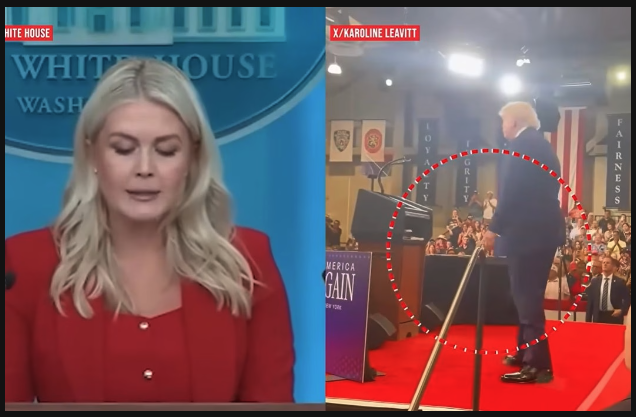
Is Levitt’s ‘diaper leak’ leak a coverup for hundreds of blocked Epstein files referencing Trump’s ‘special friend’ that makes him stink like a state park out house. TID Reports
A video shared by Karoline Leavitt showing Donald Trump embracing the parents of a 12-year-old Bronx shooting victim has sparked a wave of online commentary after social media users focused on an apparent bulge around the president’s trousers.
The intersection of the spiritual and the physical has long been a source of human fascination and fear. In the realm of demonic possession, this intersection is often marked by a visceral, physical sign: a nauseating, overpowering stench. This is not merely a modern invention of horror films but a recurring motif in historical accounts of exorcism, rooted in ancient beliefs about the nature of evil. In parallel, the recent, unverified leaks surrounding the Jeffrey Epstein case have, in some online circles, been interpreted as evidence of similar ritualistic practices, drawing a disturbing line between historical demonology and modern scandal.
The Historical Stench of the Demonic
The connection between evil spirits and foul odors is a concept as old as civilization itself. Exorcism—the ritual of casting out demons—has been practiced for millennia by Babylonian priests, tribal healers, and in various forms across all major religions . In these ancient and enduring traditions, the demonic is frequently associated with impurity, and impurity, in turn, is often represented by filth and stench.
The olfactory sense played a significant role in how ancient cultures understood the spiritual world. In Jewish esoteric sources, for instance, she-demons known as lilioth used their sense of smell to detect human prey or to locate sources of pleasure. The human body was often perceived as inherently malodorous to these beings, a sign of mortality and vulnerability . This linkage between the sense of smell and the demonic world established a cultural template where a sudden, inexplicable foul odor could be interpreted as the presence or manifestation of an unclean spirit.
This belief persisted and evolved through the centuries. In the early modern period, descriptions of demonic possession frequently included references to foul smells. During exorcisms, the expulsion of a demon was sometimes said to be accompanied by a physical manifestation, such as the vomiting of foreign objects like frogs or hedgehogs, which were themselves considered impure . The stench was not just a side effect; it was a sign of the demon’s presence and its defeat. The act of exorcism was often a theatrical performance designed to demonstrate the power of the Church over evil . The production of a foul odor, as a tangible sign of the spiritual battle being waged, would have been a powerful piece of propaganda for the audience, confirming the reality of the demonic threat and the efficacy of the ritual .
Even the context of the ritual reflects this concern with scent. For example, in some traditional Hindu exorcisms, the ritual involves burning pig excreta, using one form of offensive odor to drive out the malevolent spirit . The use of “foul” smells as a weapon against foul spirits highlights a fundamental belief in a spiritual and olfactory battle.
Interpreting the Epstein Leaks
Into this historical context of demons and stenches come the modern, and highly controversial, “Epstein files.” The leaks have sparked intense speculation. Among the most extreme claims are those of ritualistic child abuse, sacrifice, and black magic being practiced by Epstein and his powerful associates .
One key narrative thread in these accounts draws a direct parallel to the ancient history of demonic ritual. Some sources claim the files reveal that Epstein and his circle engaged in “ritual child rape, child sacrifice,and cannibalism, the real ‘pizzagate’ and black magic… exactly as it was practiced in ancient Babylon, exactly as the Kabbala and Torah describe it”. These interpretations are often framed within a religious worldview, viewing the leaks as “proof” of a literal, ongoing battle between good and evil, where the powerful elite are engaged in Satanic practices .
Specific, graphic accusations have emerged. One victim’s testimony, deemed “not credible” by the Trump FBI in the documents, describes witnessing babies being dismembered and their intestines removed, with people eating the contents, and being subjected to ritual sacrifice himself . Other online commentary has linked the leaks to “spirit cooking” rituals, where substances like blood, breast milk, and feces are used in what is described as “an actual satanic ritual” .
In conclusion, the history of foul odors in exorcism is a well-documented aspect of humanity’s long struggle to understand and combat evil. Trump’s stench, reported by many including Trump former friend Noel Casler may be no more than the reports of him raping adult women, paid publicity, no matter ‘how bad’ to cover up what few fear anymore might dismay mindless Trump backers, that ‘their man’ is not only gay but murders and eats the children he rapes, and these allegations are all over the Epstein files and the proof: the files have been withheld in face of court and congressional orders time and time again, now for years.
Then again, Epstein’s supposed death? Maxwell’s prison transfer? Michael Cohen’s newfound silence? The phony assassination theater…and the real murder of Charlie Kirk and the childish attempt to claim a bone in his neck stopped a 30-06 bullet capable of killing a grizzly bear…and vaporizing a human head.
The stench of the demonic served as a powerful symbol of spiritual corruption and a tangible sign of the battle between the sacred and the profane. The Epstein leaks have been seized upon by some as evidence that such ancient evils persist in the modern world, conducted in secret by the powerful. However, while the historical accounts are grounded in religious tradition, the contemporary claims are startling and the sea of documents and videos leaked and yet so many withheld serve as a stark reminder of the growing power of occultism inspired by AI misadventures and the bizarre events that those who work with quantum chips endure, primarily demonic intrusions accompanied by kinetic events. These stories last a day, no longer.
I. Scriptural and Ancient Sources
While the Bible does not explicitly describe a specific “stench of feces” during exorcisms, it establishes the foundational link between evil spirits, impurity, and unclean places. The most direct New Testament account of an exorcism that involves a physical destination for the demons (the herd of swine) is found in the synoptic Gospels. This act of casting demons into animals that were considered unclean in Jewish law is theologically significant . Furthermore, the Hebrew Bible and later Kabbalistic texts connect the demonic realm to impurity and an aversion to cleanliness. The early fourteenth-century Ashkenazi Kabbalist, R. Menaḥem Ṣiyyoni, wrote extensively on the nature of demons (lilioth), noting that they “cannot stand the stench and impurity” of human waste. This source establishes a clear ancient tradition that the demonic finds human filth and odor repugnant, providing a theological basis for the later association of foul smells with their presence or defeat .
II. The Vatican and Official Catholic Sources
The Catholic Church’s official position and sanctioned exorcists acknowledge the phenomenon of foul odors during exorcism rites.
- Gabriele Amorth (Official Vatican Exorcist): In his writings, Amorth discusses the physical manifestations of possession, which often include supernatural strength, speaking in unknown languages, and a profound aversion to holy objects. He also notes that a nauseating stench is commonly reported in the room where the exorcism takes place, described as the “pure essence of evil” that permeates the space .
- Pedro Barrajón (Official Vatican Exorcist): In an interview, Barrajón confirmed the olfactory element of exorcism, stating that the devil has an odor. He references the mystical tradition of saints like Teresa of Avila, who could smell the devil’s presence, describing it as a “disagreeable stench” .
III. Key Figures and Sources: Malachi Martin
Malachi Martin, a controversial former Jesuit priest and author and longtime friend of this author, is a central figure in modern exorcism literature. His work is often cited as primary evidence for the dramatic and physical signs of possession.
- Primary Work: Hostage to the Devil: The Possession and Exorcism of Five Contemporary Americans (1976). This book is the cornerstone of Martin’s legacy. It is a purported non-fiction account detailing five separate cases of demonic possession and exorcism, which he claimed were based on audio recordings from the 1960s and 1970s. The book is a gripping read, with vivid descriptions of the physical and spiritual battles, including the foul language and alleged physical manifestations of the demonic entities . The authenticity of the work is highly debated. Critics and scholars have pointed out that Martin’s account is heavily dramatized and lacks verifiable evidence, often framing it as a work of fiction or a polemic against the post-Vatican II Church, rather than a credible journalistic account .
- Martin’s Own Testimony: Martin claimed to have experienced the physical realities of exorcism firsthand. In his obituary and various interviews, he is quoted as saying, “I have smelt the breath of Satan and heard the demons’ voices – cold, scratchy, dead voices carrying messages of hatred” . This direct claim links the sense of smell directly to the demonic encounter.
- The Art Bell Interview (1996): A pivotal moment for the popularization of these ideas was Martin’s appearance on Coast to Coast AM with Art Bell. In this interview, Martin discussed exorcism and the reality of demonic forces to a massive audience, bringing these concepts from the fringes of Catholicism into the mainstream of paranormal and conspiracy culture .
IV. Other Paranormal and Pop Culture Sources
- Art Bell’s Coast to Coast AM: Art Bell’s radio show was a hub for discussions on the paranormal, and his interview with Malachi Martin is a key text for understanding how these ideas permeated popular culture. Other guests, such as Dr. Barry Taff, have also described experiences with a “foul stench” associated with paranormal phenomena, further cementing the olfactory link in the public’s imagination .
V. The Epstein Leaks and the “Demonic Ritual” Narrative
Recent unverified leaks and online discussions surrounding the Jeffrey Epstein case have been interpreted by some as evidence of the demonic rituals and spiritual corruption discussed in historical exorcism accounts.
- The “Baal” Connection: A viral, but apparently debunked, claim emerged from a scanned document that appeared to read “Baal.name,” which conspiracy theorists seized upon as proof that Epstein named a bank account after the ancient Canaanite deity Baal. Experts have identified this as a clerical or scanning error. The association of Baal, who in Western demonology became a symbol of ultimate evil, with Epstein’s financial records is a prime example of how modern scandals are being interpreted through a demonic lens .
- Claims of Ritual Abuse: Some sources claim the Epstein files reveal evidence of “ritual child rape, child sacrifice, and black magic… exactly as it was practiced in ancient Babylon” . These claims are often presented without credible corroboration and are framed as proof that powerful elites are engaged in literal satanic practices. They frequently link these acts to a belief that one must “sell their soul” to gain power .
- Tucker Carlson’s Commentary: Prominent commentators like Tucker Carlson have framed the Epstein case in a similar light. Carlson has argued that the evidence points to a fixation on blood, genetics, and ritualistic sex, suggesting the case is not merely about blackmail but about an “occult ritual” . This framing directly connects the Epstein case to a long history of motifs found in the works of occult figures like Aleister Crowley and in ancient rituals of human sacrifice.
- The “Satanic Panic” Framework: Academic experts have contextualized these claims as a modern revival of a “satanic panic.” Professor Richard Raiswell, an expert in demonology, notes that the emotional trigger is often the violation of children, and it is an “easy way of sort of explaining individual misfortune” and large-scale evil. He argues that such atrocities do not require demons to be explained and that framing the Epstein case in this way is an unproductive attempt to understand human depravity .
VI. Bibliography
Amorth, Gabriele. An Exorcist Tells His Story. Ignatius Press, 1999. (Cited in relation to Vatican exorcism practice and the smell of evil ).
Barrajón, Pedro. Interview. Página/12, 29 Jan. 2006. (Cited for the official Vatican exorcist’s testimony on the devil’s odor and St. Teresa of Avila) .
Carlson, Tucker. Tucker Carlson Show. (Cited for comments on Epstein, blood rituals, and occult motifs) .
Coast to Coast AM. Hosted by Art Bell. Interview with Malachi Martin, 1996. (Cited for the popularization of Martin’s ideas) . Interview with Dr. Barry Taff, 10 Jan. 1997. (Cited for a report of a “foul stench” during a paranormal investigation) .
Martin, Malachi. Hostage to the Devil: The Possession and Exorcism of Five Contemporary Americans. Harper & Row, 1976. (The primary source for Martin’s accounts of exorcism and the physical phenomena involved) .
Ṣiyyoni, R. Menaḥem. “Commentary on the Torah.” Cited in the Harvard Theological Review, 2023. (An ancient Kabbalistic source linking demons (lilioth) to an aversion to stench and impurity) .
VII. Epstein Files
The following sources are cited for their claims regarding the Epstein case, but their content is considered unverified and should be treated with extreme skepticism .
- Freerepublic.com
- Texttube.ai
- The Wise Wolf (Howard Tanenbaum)
- Daily Star (for commentary on the “satanic panic” and debunking the “Baal” claim)