
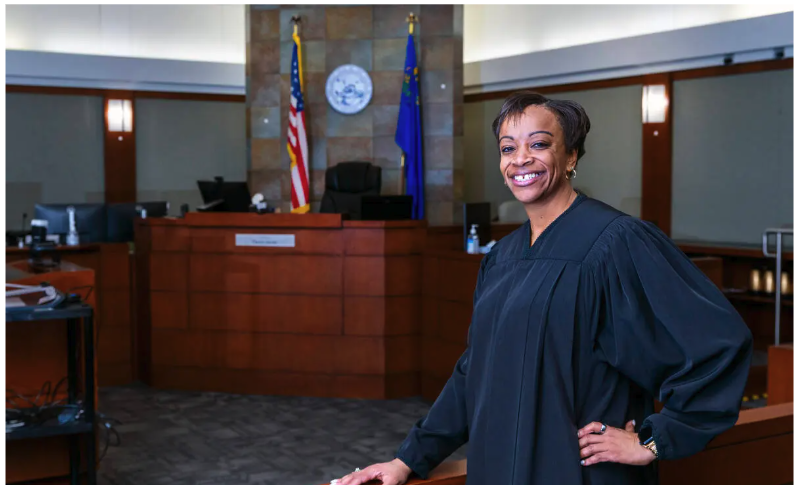
District Judge Tierra Jones stands for a portrait in her courtroom on Thursday, Jan. 29, 2026, in Las Vegas. (L.E. Baskow/Las Vegas Review-Journal) @Left_Eye_Images
Chief Judge Tierra Jones Promised Neutrality, Transparency, and Justice—Then Refused to Address a Documented Judicial-Abuse Record
By Austin Sachs
For more than six years, my wife and I have been trapped in a criminal prosecution in the Eighth Judicial District Court in Clark County, Nevada, arising from allegations that we abused or neglected my medically fragile stepson, Yichen “Eason” Liu.
We have consistently maintained our innocence. Our position is that Eason suffered a serious medical decline after receiving the gadolinium-based MRI contrast agent Gadavist at University Medical Center Children’s Hospital in Las Vegas in January 2019, and that his resulting medical injuries were wrongly transformed into a child-abuse prosecution against his parents.
By 2025, the defense had secured testimony from Dr. Richard Semelka, an internationally recognized radiologist and gadolinium expert. On September 5, 2025, District Judge Jessica Peterson permitted Dr. Semelka to testify and acknowledged that his testimony could change the “tenor of the trial and ultimate result.”
That should have moved the case toward a jury trial where the medical evidence could finally be heard.
Instead, the prosecution orally requested that the case be stopped. Judge Peterson granted an immediate stay even though the State had filed no written stay motion, no interlocutory appeal, no writ petition and no appellate stay order. The defense maintained that the State was effectively given emergency protection from the possibility of losing at trial after the court admitted powerful medical-causation evidence.
Three days later, what was ostensibly a routine calendar call became a no-bail warrant proceeding.
The prosecutor claimed that my wife and I had violated a no-contact order involving our son. Yet both appointed defense attorneys told the court that they had searched the record and could not locate the supposed order. The prosecutor fell back on a notation written on a 2019 indictment summons, an appearance document, not a separately entered and indefinitely enforceable parental no-contact order.
Nevertheless, Judge Peterson issued no-bail warrants against both parents during the calendar call, without the State first producing the order allegedly violated. She then vacated the trial date and all remaining dates. The motion later submitted to Chief Judge Tierra Jones described this extraordinary sequence: the defense medical expert was admitted, the State obtained an oral stay, an off-record bench conference followed, and the next court date was converted into a warrant proceeding based on an order nobody could produce.
The warrants were not a harmless scheduling mistake. They threatened arrest, incarceration, family separation and enormous coercive leverage against two presumed-innocent parents caring for a medically fragile child. The court imposed that threat even though the prosecutor had not produced the alleged no-contact order and defense counsel expressly stated that they could not find it.
Nine days later, on September 17, Judge Peterson acknowledged in open court that no separate written no-contact order had been located and directed the State to prepare one. A sealed no-contact order was then entered on September 18, after the no-bail warrants had already been issued.
That sequence raised a devastatingly simple question: how could a later order retroactively validate warrants based on an order the State had failed to produce before the warrants were issued?
The pressure did not end there.
In November 2025, while Eason was undergoing a previously scheduled video-EEG admission at Arkansas Children’s Hospital, Nevada’s no-contact allegations became entangled with Arkansas child-protection authorities. Eason was removed from our custody. The Nevada prosecutor then sought to remand my wife into custody. Unresolved issues involving judicial disqualification, defense-counsel conflict, statutory divestiture, the validity of the supposed no-contact order and the Arkansas removal remained hanging over the family.
On November 18, 2025, I filed a motion and affidavit seeking to disqualify Judge Peterson. The following day, she filed her own affidavit defending the disputed no-contact premise and the September 5 stay. She asserted that a no-contact order had been issued “with the Indictment Summons” in 2019 and had never expired. She also defended the trial-stopping stay.
Those sworn positions became independently significant because the forthcoming plea-withdrawal motion would challenge the same premises. Judge Peterson would be asked to decide whether her own rulings, reasoning, affidavit representations and handling of the remand pressure helped create the coercive conditions under which the plea was entered.
By December 3, 2025, the pressure had become intolerable. I entered a guilty plea while my wife faced surrender and incarceration, our child had been taken in Arkansas, and the State’s no-contact and remand machinery threatened to keep our family separated. The plea resulted in dismissal of the charges against my wife, termination of the remand pressure and lifting of the no-contact restriction.
My position is that this was not a voluntary plea. It was the product of a State-driven and court-enabled coercion chain.
Waiting for a New Chief Judge
I deliberately waited approximately two months for Chief Judge Tierra Jones to replace former Chief Judge Jerry Wiese before filing a new motion to disqualify Judge Peterson.
I hoped a new chief judge would independently examine the record rather than continue the institutional pattern that had protected Judge Peterson from meaningful scrutiny.
On July 13, 2026, I filed a detailed motion and affidavit explaining why Judge Peterson could not preside over the next stage of the case. The motion identified a straightforward two-step sequence.
Step One: Disqualify Judge Peterson before she is permitted to decide a motion challenging her own conduct.
Step Two: File a post-sentence motion under NRS 176.165 asking the court to set aside the conviction and permit withdrawal of the December 3, 2025 plea to correct manifest injustice.
The filing did not conceal or vaguely imply that purpose. It announced the forthcoming plea-withdrawal motion on its first page, explained the direct conflict on its second page, repeated the sequence in the introduction and expressly addressed NRS 176.165 later in the motion. The requested relief was immediate assignment to a neutral judge before the plea-withdrawal motion was filed.
The motion explained that the future plea-withdrawal proceeding would challenge the September 5 stay, the September 8 warrants, the supposed no-contact order, the later sealed order, the Arkansas consequences, the remand pressure, Judge Peterson’s sworn affidavit and the December 3 plea. Judge Peterson had presided over, participated in or defended the critical events she would later be asked to evaluate.
Judge Peterson did not file a timely written answer under NRS 1.235(7) responding to the new affidavit. The sworn factual allegations therefore remained unrebutted by the challenged judge.
Chief Judge Jones initially scheduled a hearing for July 29.
Then, on July 27, she canceled the hearing and denied the entire motion without addressing the substantive allegations.
The Procedural Escape Hatch
Chief Judge Jones did not determine whether Judge Peterson could impartially decide a motion challenging her own conduct.
She did not address the September 5 stay.
She did not address the illegal no-bail warrants.
She did not address the missing no-contact order.
She did not address the later SEALED no-contact order to our own son of which we were denied a copy of.
She did not address the Arkansas child-removal consequences.
She did not address the remand pressure against my wife.
She did not address Judge Peterson’s disputed sworn affidavit.
She did not address Judge Peterson’s failure to answer the new disqualification affidavit.
She did not address the thirty-six separately identified violations of the Nevada Supreme Court’s judicial-bias standard for disqualification.
Instead, Jones denied the motion on one narrow premise:
“Pursuant to NRS 1.235, a party may seek to disqualify a judge for bias or prejudice in an ‘action or proceeding pending’ before the court. Here, the Court finds that Defendant’s Judgment of Conviction was filed on December 4, 2025 and the instant case was closed.”
Because the judgment had already been entered, Jones concluded there were “no matters pending before Judge Peterson” and therefore nothing from which Peterson could be disqualified.
That rationale did not resolve the motion. It avoided it.
The entire reason for filing the disqualification motion first was to prevent Judge Peterson from hearing the forthcoming post-sentence proceeding under NRS 176.165. Nevada law expressly permits a district court, after sentencing, to set aside a judgment and allow withdrawal of a guilty plea to correct manifest injustice.
The judgment was not an obstacle to the forthcoming proceeding. The judgment was the very judgment I intended to ask the district court to set aside.
Jones effectively ruled that I could not disqualify Peterson because the NRS 176.165 motion had not yet been filed, even though my motion repeatedly explained that Peterson had to be disqualified before the NRS 176.165 motion was filed so she would not be placed in the position of judging her own conduct.
Jones demanded Step Two as a condition for deciding Step One, even though Step One existed to ensure that Step Two would be heard by a neutral judge.
That is circular reasoning masquerading as procedure.
Her rationale was self-contradictory in another respect. The July 13 disqualification motion was itself a filed, served, scheduled and undecided statutory proceeding. Department 10 exercised judicial authority over that proceeding, reviewed it and entered an order adjudicating it. The court could not logically exercise jurisdiction to decide the proceeding while simultaneously declaring that no proceeding was pending. The act of deciding it proved that it was pending immediately before Jones disposed of it.
The order also misidentified the motion as the “Plaintiff’s Motion,” even though I, the defendant, filed it. It cited a civil-practice rule in deciding a motion arising from a criminal case. Most critically, it failed to address the announced NRS 176.165 proceeding, Judge Peterson’s failure to answer, or any substantive disqualification ground.
This was not a reasoned rejection of the allegations.
It was a procedural trapdoor.
Compare the Order With Jones’s Public Promises
Only months earlier, Chief-Elect Jones appeared on a Las Vegas television program presenting herself as a champion of justice, neutrality, respect and transparency.
She told viewers:
“Everybody deserves respect.”
She said that principle “starts at the top” and therefore starts with her. She claimed her daily goal was for everyone to leave feeling “respected” and “heard,” regardless of their circumstances.
She also declared:
“I want to make sure that people believe and trust in me being the neutral and that I’m here as the neutral and I can see both sides of this story.”
She spoke of preparing ahead of time so she could understand what was happening in each case and avoid creating the appearance that one side was being favored.
At the conclusion of the interview, the hosts praised her supposed respectfulness and transparency. Jones responded that she looked forward to transparency because “this is the public’s court.”
The public should compare those promises to her July 27 2026 order denying my 91 page motion to disqualify Judge Jessica Peterson.
Was I “heard” when the order ignored the explicitly stated two-step sequence?
Was the record meaningfully reviewed when the order overlooked NRS 176.165 even though the forthcoming plea-withdrawal proceeding was announced repeatedly?
Was neutrality demonstrated by refusing to examine whether Judge Peterson should decide the legality of her own conduct?
Was transparency served by canceling the scheduled hearing and issuing a denial that never confronted the factual allegations?
Was justice done by reducing 91 pages of documented judicial misconduct to a brief claim that nothing was pending, even while the court was deciding a pending motion and while Nevada law expressly authorizes post-sentence proceedings?
Jones said respect begins at the top.
So does accountability.
Chief judges are not elected by their colleagues merely to manage courtrooms and shuffle case assignments. When assigned to decide judicial disqualification, they are entrusted with protecting the constitutional requirement of a neutral tribunal. That responsibility cannot be discharged by finding the narrowest procedural excuse to avoid confronting the record.
Chief Judge Jones had an opportunity to demonstrate that a new administration would mean genuine judicial accountability.
Instead, her first significant action in this matter perpetuated the same institutional self-protection that has defined this prosecution for more than six years.
The contrast could not be clearer:
On television: neutrality, respect, transparency, preparation and justice.
In the written order: no hearing, no merits analysis, no discussion of the unrebutted affidavit, no consideration of the forthcoming statutory proceeding and no answer to the central constitutional question.
The public does not need another carefully staged interview about judicial integrity. It needs judges whose written decisions demonstrate it. When a judge publicly promises neutrality, transparency, respect, and a commitment to ensuring that litigants are heard, then issues an order that, in my view, avoids the central issue, ignores the announced statutory proceeding, and refuses to engage the merits of the motion, the public is entitled to judge whether those words were genuine. Based on this record, I believe Chief Judge Tierra Jones has proven herself to be a hypocrite.
On July 29, 2026, I filed a motion asking Chief Judge Jones to rehear and reconsider her denial. Based on the record to date, I have very little confidence that she will now fairly confront the issues presented rather than rely on another procedural device to avoid them. I am therefore making this record public now. I have no reasonable basis to believe that Chief Judge Jones will provide the neutral and impartial review that due process requires.
I have a constitutional right to clear my name. Every judge who refuses to meaningfully address the record becomes another obstacle to that fundamental right. Regardless of how long it takes, I intend to continue documenting and publicly exposing what I believe to be systemic judicial misconduct in this case. If our system did not provide judges with extraordinarily broad judicial immunity from civil liability for their judicial acts, many of the actions described throughout this record would, in my opinion, warrant serious civil litigation and independent scrutiny.
LINK TO JONES’S YOUTUBE VIDEO, “A Conversation With Chief-Elect Judge Tierra Jones | The Investigators”:
For those who wish to learn more about what amounts to an iatrogenic gadolinium medical injury that led to a wrongful criminal prosecution, the Eighth Judicial District Court case number is C-19-343540-1 & 2. I encourage you to follow this case, review the public filings for yourself, and draw your own conclusions. Public accountability begins with an informed public.