
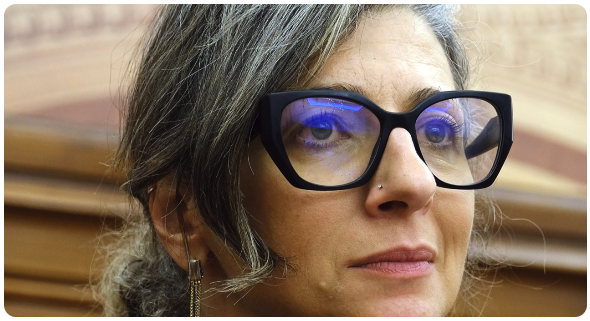
By Esquerda.net – Encontro com relatora especial da ONU, Francesca Albanese – Out.24, CC BY-SA 2.0, https://commons.wikimedia.org/w/index.php?curid=16
Why Francesca Albanese Deserves the Nobel Peace Prize (and a Cup of Tea and a Biscuit Too)
Roel Schrijvers
In a world where peace prizes have been handed out to both the architects of war and the decorators of bomb shelters, you’d be forgiven for wondering whether the Nobel Committee chooses its laureates by consulting the entrails of a particularly confused Norwegian herring. Consider Henry Kissinger, who received the Nobel Peace Prize while large parts of Southeast Asia were still on fire. By comparison, nominating Francesca Albanese is rather like handing someone an umbrella when it’s already raining: sensible, long overdue, and still just in time to stop a soaking.
Francesca Albanese is not one for tiptoeing. She doesn’t say “on the one hand” unless the other hand is holding a legal brief, a pair of scales and the moral weight of an occupied nation. As the UN Special Rapporteur on human rights in the Palestinian territories, she combines legal precision, diplomatic clarity and the sort of courage that tends to get you unfollowed by ambassadors and sanctioned by governments.
Which, incidentally, is exactly what happened. The Trump administration, never one to let a functioning international norm go unpunished, slapped her with sanctions. Sanctions. Not for launching drones or laundering money, but for publishing reports. That tells you two things. First, that she’s doing her job exceptionally well. And second, that some people are astonishingly bad at reading Article 19 of the Universal Declaration of Human Rights. That’s the one about freedom of opinion and expression, for anyone who skipped Civics.
Her critics, mostly huddled in the well-upholstered corner of global politics where occupation is rebranded as real estate management, accuse her of bias, because she insists on applying international law as if it actually applies to everyone. This is, apparently, controversial. Imagine a football referee getting booed for enforcing the offside rule, except instead of a whistle, she’s holding the Geneva Conventions and every player has a lobbyist.
So what has she done, exactly? She’s called out Israel’s system of apartheid. She’s warned of genocide in Gaza. She’s named Alphabet, Amazon, Microsoft, which is particularly bold when you consider that some of those companies can read your emails and finish your sentences. She hasn’t sat on the fence; she’s climbed it and yelled, “There’s a fire in the village, and someone’s making off with the hose.”
Also, she’s never tried to make peace by dropping it from thirty thousand feet. That alone should put her on the shortlist.
Now, the Nobel Committee does its work behind closed doors, shrouded in tradition, strong coffee and the sort of secrecy that would make a papal conclave blush. But one hopes that, somewhere amid the reports and the whispers, someone will stand up and say: “This year, let’s give it to the woman who stood between power and truth with nothing but a law degree and a spine.”
Awarding the Nobel Peace Prize to Francesca Albanese wouldn’t just honour her work. That’s the bare minimum, like tossing a life line to the only person in the UN still shouting “man overboard.” It would also remind the world that peace is not the absence of war. If that were the bar, a desert after a massacre would qualify. No, real peace is the presence of justice, of dignity, of a legal system that doesn’t treat international law like a salad bar (take the right to self-defence, leave the obligation not to flatten hospitals).
Peace isn’t quiet. Silence can be bought, beaten or buried. Real peace is noisy. It challenges. It investigates. It challenges, argues and cross-examines. It sends firmly worded letters to those who prefer their human rights with a side of plausible deniability. Giving the prize to Albanese would be like hanging a sign on the world stage that says, “We still know the difference between a ceasefire and a smokescreen.” It would say that accountability isn’t bias, that naming war crimes isn’t extremism and that applying the same rules to everyone is not antisemitism. It’s what we used to call Law before the PR departments took over.
And yes, it would annoy exactly the right people. And if peace doesn’t come with a little righteous irritation in the right quarters, you’re probably not doing it properly. So no, this isn’t just about Francesca Albanese. It’s about what we signal to the world when someone tells the truth under oath and under pressure and then we musn’t look away.