
By Monica Alba, Alexandra Marquez, Owen Hayes and Kyla Guilfoil
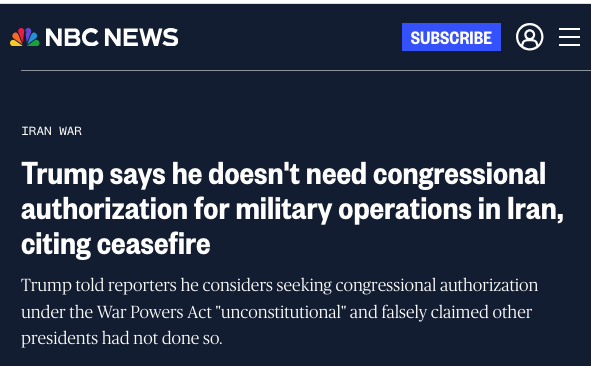
President Donald Trump on Friday sent letters to Congress explaining that, due to the ceasefire, he doesn’t need its authorization for military operations in Iran, even though the conflict hit the 60-day mark this week.
“On April 7, 2026, I ordered a two-week ceasefire. The ceasefire has since been extended. There has been no exchange of fire between the United States Forces and Iran since April 7, 2026. The hostilities that began on February 28, 2026, have terminated,” Trump wrote in the letters, one of which went to the House and one of which went to the Senate.
“Despite the success of United States operations against the Iranian regime and continued efforts to secure a lasting peace, the threat posed by Iran to the United States and our Armed Forces remains significant,” the president added in the letter, promising to keep congressional leaders updated on further developments in Iran.
The letters come as congressional leaders this week faced mounting questions about whether they planned to schedule votes on a formal war authorization from Congress.
The 1973 War Powers Resolution directs the president to seek authorization for war from Congress after an ongoing military conflict hits the 60-day threshold. The law allows for a president to seek a 30-day extension if necessary to safely remove troops from the region, but Trump did not mention that in his letter.
“I have and will continue to direct United States Armed Forces consistent with my responsibilities and pursuant to my constitutional authority to conduct United States foreign relations and as Commander in Chief and Chief Executive,” the president wrote in his letter.
The U.S. military strikes on Iran officially began on Feb. 28, but the Trump administration notified Congress of the conflict on March 2, starting the 60-day clock then.
A temporary ceasefire went into effect on April 8 to allow the U.S. and Iran room to negotiate an end to the war and to reopen the Strait of Hormuz, but talks have not produced results.
Iran has blocked traffic in the Strait. The U.S. has a naval blockade of the Iranian ports and is using more than 100 fighter and surveillance aircraft, two carrier strike groups, and more than one dozen ships to enforce the blockade. A Navy destroyer fired on and hit an Iranian-flagged cargo that attempted to move through the blockade.
Michael Glennon, a professor of constitutional and international law at The Fletcher School at Tufts University, told NBC News that Trump’s argument for not needing congressional authorization “is a stretch” and that he does not believe “that the administration is correct in arguing that the clock has stopped.”
“The hostilities are continuing as a consequence of the administration’s enforcement of the blockade,” said Glennon, who served as legal counsel to the State Department under the George W. Bush administration and to the Senate Foreign Relations Committee in the 1970s when he handled legal matters like the War Powers Resolution.
“That’s not a ceasefire. It’s not a suspension of hostilities,” Glennon added. “If the ceasefire were a genuine and comprehensive ceasefire that involved a cessation of hostilities, which to say if the war ended, of course, the clock would stop. But the war has not ended.”
Stephen Pomper, chief of policy at the International Crisis Group who served as senior director for multilateral affairs and human rights at the National Security Council during the Obama administration, also cited the naval blockade in an interview with NBC News.
“That is a hostile act,” he said. “It’s an act of war. It’s an act that puts U.S. troops at risk.”
“So, if this isn’t a situation that’s covered by the definition of hostilities, what is?” he added.
In a statement released Friday, Reps. Gregory Meeks (D-N.Y.), ranking member of the House Foreign Affairs Committee, Adam Smith (D-Wash.), ranking member of the House Armed Services Committee, and Jim Himes (D-Conn.), ranking member of the House Intelligence Committee, argued that the ceasefire does not stop the clock for the War Powers Resolution.