
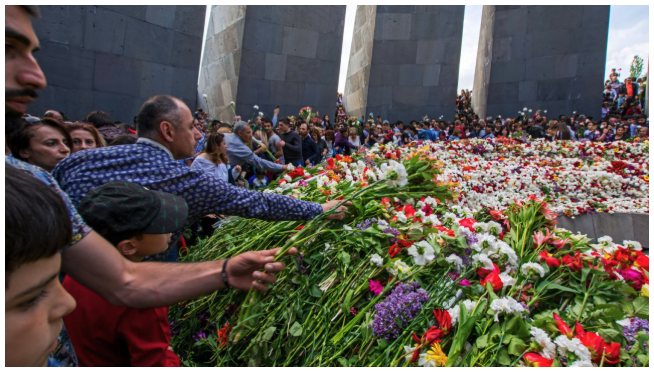
The breakup of states in the Middle East is often accompanied by waves of ethnic or sectarian violence.
By: Stephan Pechdimaldji
As the Iran War enters its sixth week, the world’s attention is understandably centered on the smoke rising above Tehran and the paralyzed shipping lanes of the Strait of Hormuz. With the Iranian regime facing an existential crisis and Supreme Leader Mojtaba Khamenei reportedly incapacitated, the international community is already drafting blueprints for a “New Middle East.” However, if these plans ignore the century-old lessons of the Armenian Genocide, they risk repeating a cycle of ethnic erasure that could set the entire region ablaze.
To many, the 1915 Ottoman slaughter of 1.5 million Armenians feels like a distant historical footnote. But in the context of the 2026 Iran War, it is a living model for disaster.


The current conflict has already placed Armenia at a dangerous crossroads. With Azerbaijan and Turkey potentially looking to exploit a weakened Tehran, Armenia’s southern province of Syunik has become one of the most contested patches of land in Eurasia. For years, Azerbaijan and Turkey have lobbied for the “Zangezur Corridor,” a land bridge through Armenian territory that would physically connect the Turkic world.
Despite the Trump administration’s push for the Trump Route for International Peace and Prosperity (TRIPP)—which proposes a 99-year lease for a private US company to manage the transit route—there are no sufficient guarantees for Armenian sovereignty. Instead, it might enable the same predatory patterns that preceded the 1915 genocide, with the exploitation of a global conflict to rectify borders through the removal of indigenous populations.
We have seen this playbook before. In 2020, under the cover of a global pandemic and a US election, Azerbaijan launched an illegal war against Armenia that culminated in the forced displacement of more than 120,000 Armenians from their ancestral homeland of Nagorno-Karabakh in 2023. If Syunik falls to an Azerbaijani-Turkish incursion under the cover of the chaos of an Iranian state collapse, the result might not just be a new road, but the ethnic cleansing of the last remaining Armenian stronghold in the region.
The central tragedy of modern Armenian history is how international silence greenlit further atrocities. In 1939, Adolf Hitler famously asked, “Who, after all, speaks today of the annihilation of the Armenians?” He understood that unpunished crimes are invitations to repeat them.




That is why increased international recognition of the Armenian Genocide, an event that Turkey and Azerbaijan both deny to this day, is not merely a symbolic gesture but rather a strategic deterrent. It sends a message to Baku and Ankara that the international community is finally watching. Official recognition transforms the Armenian border from a local dispute into a global human rights frontier.
What’s more, if Azerbaijan and Turkey are serious about regional stability and peace, then they must officially acknowledge the genocide (April 24, Armenian Genocide Remembrance Day, would be a fitting date). Anything short of full recognition, devoid of verbal gymnastics and euphemisms, should be viewed as a telltale sign of malicious intentions.
Furthermore, Iran itself is a mosaic of ethnicities, including a significant Armenian minority and a massive Azerbaijan population in the northwest. As the war threatens to fragment the Iranian state, the risk of internal cleansing or retaliatory ethnic violence mirrors the darkest days of Iraq and Syria in the 2000s and 2010s. A world that has fully reckoned with the Armenian Genocide is a world better equipped to monitor and prevent similar atrocities against the Kurds, Balochis, Arabs, Azeris, and Armenians within a destabilized Iran.
We cannot build a stable post-war order on a foundation of historical amnesia. If the goal of the current intervention in Iran is to bring peace and prosperity to the region—as the proposed Trump Route for International Peace and Prosperity suggests—that peace must be grounded in the sanctity of existing borders and protection of vulnerable groups.
Recognizing the Armenian Genocide today is an act of preventive diplomacy. It tells survivors of the past and the potential victims of the future that the era of forgotten massacres is over. If we fail to acknowledge the ghosts of 1915 now, we are simply inviting them to haunt the ruins of 2026.