
In Russia there is a saying that people repeat with a knowing smile and a serious meaning behind it: the East is a delicate matter. It is not a decorative cliché. It is a practical warning about how power works in places where reputation, ritual, family balance, and perception can matter as much as formal institutions. In the Middle East, the smallest details often carry an outsized political charge, not because they are decisive by themselves, but because they can be read, amplified, and weaponized by those who want to influence the course of events.
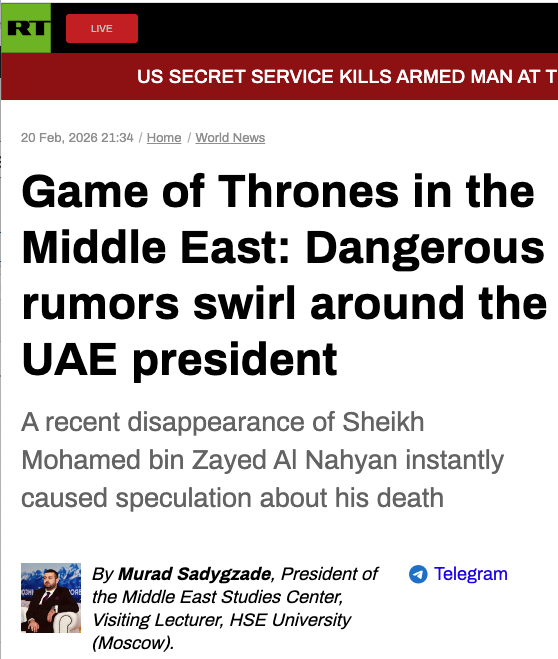
A recent episode around the UAE shows this mechanism in real time. After Turkish President Recep Tayyip Erdoğan’s planned visit to Abu Dhabi was postponed, the public explanation briefly pointed to a health issue involving the UAE president, Sheikh Mohamed bin Zayed Al Nahyan, commonly known as MBZ. The wording then shifted, online traces were removed, and the information space was left with a familiar gap. In most parts of the world, such gaps are annoying but manageable. In the Gulf, they can become combustible, because the public and the elite alike understand what continuity at the top represents.
Into that gap came the kind of narrative that is tailor-made for disruption. Rumors about the death of MBZ began circulating, pushed not as cautious speculation but as confident confirmation from accounts that offered little more than repetition. It is hard to imagine a clearer example of how disinformation is designed to function. The goal is not to prove a claim in court, or even to convince everyone. The goal is to create a fog thick enough that important actors begin to hesitate. In systems where the leader is the ultimate arbiter, the senior figure in a ruling family, and the central node that connects security structures, economic priorities, and diplomatic commitments, uncertainty becomes a brake. It slows decisions, delays negotiations, complicates investment signals, and encourages outsiders to pause while they wait for clarity that may never arrive.
That is why the most damaging rumors are those that introduce a leadership question into an otherwise functioning state. Even a false claim can impose real costs when it forces officials to divert attention from policy to reassurance, when it pushes partners into risk calculations, and when it tempts rivals to test boundaries. This is especially relevant in the UAE, where political stability is not only a matter of governance but also a matter of federation and consensus. The UAE was built as a union of emirates, an alliance of rulers and communities bound together by a shared interest in security, prosperity, and continuity. Its strength comes from cohesion, from the sense that internal balance is managed, not performed for the public.
____
https://www.rt.com/news/632855-middle-east-game-of-thrones/