
On 8/23/2026 at 1:59 PM, Keven Hofeling said:
J. KEVEN HOFELING, ESQ.
JFK ASSASSINATION RESEARCH • DISTRIBUTION LIST WORK PRODUCT
Salt Lake City, Utah · j.keven.jd@jkhofelinglaw.org · https://jkhofelinglaw.org/
A SPECTRE IS HAUNTING THE JFKA RESEARCH COMMUNITY
— A RESPONSE IN THREE PARTS — PART I OF III
The Apparatus and Its Published Doctrine
Dispatch 1035-960, COINTELPRO, and the Continuum That Runs From Mail Covers to JTRIG
J. KEVEN HOFELING, ESQ. • AUGUST 2026
THIS SERIES Part I — The Apparatus and Its Published Doctrine (this installment)
Part II — My Own Account
Part III — The Ultimate Price, and a Field Manual
Each part stands alone; together they answer the whole question. The three installments are being circulated a day apart.
CONTENTS OF PART I Foreword — The Question, and the Larger Question Behind It
I. What This Is Not, and What It Is
II. Something Is Rotten in the State of Denmark
III. The Continuum: From COINTELPRO to JTRIG
IV. What Comes Next in This Series
Sources for Part I (Hyperlinked)
Foreword — The Question, and the Larger Question Behind It
Robert, thank you for asking. I have been meaning for years to set down in one place what I know from my own experience about the surveillance, co-optation, and harassment of researchers who look too closely at the criminal political events of the 1960s and their long shadow. Your inquiry on the Education Forum (Topic 32227), and Dr. Peter Dale Scott’s striking answer to it, gave me the push.
Because the answer runs long, and because Bill Simpich has fairly reminded me that my missives do, I am going to give it to you in three installments you can actually finish, a day apart. Part I, this one, sets out the apparatus and its published doctrine — what the government itself has admitted, in its own paper. Part II is my own account, from a pool hall in Murray, Utah in the early 1990s to a three-minute window in April 2025. Part III is the price — what it cost the journalist Gary Webb — and a field manual for the researcher who would rather not pay it.
But this is not only an answer to you. It is addressed, with respect and some urgency, to the far larger number of researchers who did not answer you — and to the one observation in the thread I cannot get out of my head. John Simkin, who has done more than any living person to preserve this field’s record, wrote on August 14:
“I am surprised that not more people have not posted on this thread. Maybe, after all these years, the ruling elite do not think our work is important enough to discredit us.” — John Simkin, Education Forum, Topic 32227 (Aug. 14, 2026)
I want to take that sentence seriously, because I think it is exactly backwards — and because the fact that a man of Mr. Simkin’s stature can arrive at it is itself the best evidence for the thesis of this series. The silence in that thread is not evidence that no one is being worked on. It is the product of the work. A counterintelligence program that leaves its targets convinced they are too unimportant to be targeted has not failed. It has succeeded completely.
So: a spectre is haunting the JFKA research community. Most of us have been trained — by the movies, by the sneer that attaches to the words “paranoid” and “conspiracy theorist,” and by a great deal of patient effort on the part of people who are paid to produce that sneer — to treat clandestine political operations as a genre of entertainment rather than a documented feature of American life with a fifty-year paper trail. Meanwhile every legitimate researcher in this field is a pawn on a chess board where the stakes include the public disclosure of government crimes, the possibility of prosecution, and the shutting down of a financial gravy train without precedent in human history. Those are not small stakes. People do not leave stakes like that unattended.
What follows is my account and my evidence. I have tried to make it useful rather than merely alarming: every substantiating document, video, and archive I rely on is linked where I rely on it, and gathered again in a source table at the foot of each installment, so that the bona fide researcher who wants to get to the bottom of these matters has the underlying material in hand rather than my summary of it.
“Full knowledge leads to right action, and without full knowledge, right action is impossible.” — Founding principle of the Inner-Direct Sect, ca. 1991, based upon Jeffersonian Democratic Theory
I. What This Is Not, and What It Is
Let me say at the outset what I am not claiming. I have never found a bug in my telephone. I have never come home to a jimmied door and a missing hard drive. I cannot tell you that there is a file on me, because I have not seen it, and neither has anyone else who has not seen it.
What I can tell you is narrower and, I think, more useful — because it is documented, and because it happened to me. The counterintelligence apparatus this community talks about does not spend most of its effort kicking in doors. Kicking in doors is expensive, legally exposed, and it creates martyrs. The cheap and far more effective work is done upstream: identify the person early; evaluate whether he can be turned; turn him if he can be; and if he cannot, degrade his reach and his credibility until he is talking only to himself.
That is not my theory. That is published doctrine, and I will cite it below. I believe I have been on the receiving end of both halves of the sequence — the recruitment approach as a very young man, and the reach-degradation as an old one. That is Part II’s business. This installment establishes that the machinery I say was pointed at me exists, is admitted, and is still running.
II. Something Is Rotten in the State of Denmark
I read David S. Lifton’s Best Evidence (Macmillan, 1980) when I was fourteen years old, in the early 1980s. It did to me what it did to a great many people: it moved the assassination out of the category of history and into the category of evidence. Once you understand that the medical evidence is where this case actually lives, and that the medical evidence does not say what the Warren Report says it says, you cannot go back.
From there I read everything I could locate — and what I found alongside the assassination literature was a second literature: the record of what the intelligence agencies had done to the people who investigated the first one. By my late teens I was subscribing to The Nation, Mother Jones, and The Progressive, which is an unusual reading list for a teenager in Murray, Utah, and which is precisely the point I will return to in Part II.
Two documents from that period matter for everything that follows, and both are now beyond dispute.
The first is CIA Dispatch 1035-960, “Countering Criticism of the Warren Report,” dated 1 April 1967 — the Agency’s own instruction to its stations, released under FOIA in 1976 and archived at History Matters as RIF 104-10406-10110. It directs officers “to discuss the publicity problem with … friendly elite contacts (especially politicians and editors),” and “to employ propaganda assets to [negate] and refute the attacks of the critics,” noting that “[b]ook reviews and feature articles are particularly appropriate for this purpose.” It further instructs that critics be answered with the suggestion that “parts of the conspiracy talk appear to be deliberately generated by Communist propagandists.” That dispatch is the origin point of the reflex by which the phrase “conspiracy theorist” now does the work that evidence used to do.
The second is the Church Committee’s Final Report, Book III (1976) (Senate Select Committee, full PDF), which set out COINTELPRO’s stated purpose in the Bureau’s own vocabulary — to “expose, disrupt, misdirect, discredit, or otherwise neutralize” domestic political activity — and which concluded, in language every researcher in this field should have memorized, that “the Bureau conducted a sophisticated vigilante operation aimed squarely at preventing the exercise of First Amendment rights of speech and association.”
Neither of these is a theory. Both are government paper.
DOCUMENT EXHIBIT A CIA Dispatch 1035-960 — “Countering Criticism of the Warren Report” (1 April 1967)
https://www.history-matters.com/archive/jfk/cia/russholmes/104-10406/104-10406-10110/html/104-10406-10110_0002a.htm
https://archive.org/details/CIADOC1035960
DOCUMENT EXHIBIT B Church Committee, Final Report, Book III (1976) — COINTELPRO
https://www.intelligence.senate.gov/sites/default/files/94755_III.pdf
The dissent that wasn’t
I started college at about the time Oliver Stone’s JFK was released in December 1991. By then I knew enough of the actual record to watch the reaction with a certain grim clarity — because the most ferocious attacks on the film did not come from the right. They came from the respectable left. Alexander Cockburn devoted column after column in The Nation to demolishing Stone and the assassination critics generally, and Noam Chomsky published Rethinking Camelot (South End Press, 1993) in the same register: that it does not much matter who killed Kennedy, because Kennedy was no different from Johnson.
To a young man who had already read the autopsy evidence, this was the moment the picture came into focus. The magazines I had subscribed to precisely because they were supposed to be adversarial to the national security state were among those ones running interference for it on the single clearest case of its criminality. Something smelled rotten in Denmark.
I do not assert that Cockburn or Chomsky were assets, and I will not. I assert something I think is more interesting and better supported: the boundary-policing function described in CIA Dispatch 1035-960 does not require assets. It requires only that a respectable person’s professional standing be made to depend on his not going there. Once the Agency has spent two decades cultivating “friendly elite contacts” in the press — the practice Carl Bernstein documented at length in “The CIA and the Media,” Rolling Stone, October 20, 1977, drawing on the Church Committee’s own files — the boundary maintains itself. That is the durable meaning of what is loosely called Operation Mockingbird: not a permanent payroll, but a permanent reflex.
Mr. Simkin’s own testimony in your thread is the cleanest confirmation of this I have seen from inside the profession. He worked for The Guardian, he wrote, “the UK’s most liberal newspaper,” and “they would not publish articles that questioned the Warren Commission report.” Denise Hazelwood reported in the same thread that she was banned from Daily Kos as a “conspiracy theorist” for submitting a piece on the evidentiary anomalies. Neither of those is a wiretap. Both are the dispatch, working as designed, sixty years on.
ARTICLE EXHIBIT C Carl Bernstein, “The CIA and the Media,” Rolling Stone (Oct. 20, 1977)
http://www.carlbernstein.com/the-cia-and-the-media-rolling-stone-10-20-1977
III. The Continuum: From COINTELPRO to JTRIG
The mistake most researchers make is to treat COINTELPRO as history. It is not history. It is the first generation of a program that was never dismantled — only professionalized, privatized, digitized, and made deniable. The table below is the shape of the thing.
TABLE 1 — THE CONTINUUM OF DOMESTIC COUNTERINTELLIGENCE AGAINST RESEARCHERS
Era Named Doctrine Characteristic Methods Who Pays, and How It Is Deniable 1956–1971
AnalogCOINTELPRO (FBI); CIA Dispatch 1035-960 (1967); domestic mail covers Infiltration; mail opening; wiretaps; anonymous letters; planted press items; “neutralization” of individuals by reputation attack Direct federal employees. Deniability rests on classification alone — which is why it collapsed in 1971–1976. 1972–2000
TransitionalCultivation of assets; “friendly elite contacts”; Domestic Contact Service debriefings of returning travelers Recruitment approaches to promising young activists; honey traps; professional placement of critics into institutional roles; media boundary maintenance Contract and cut-out relationships. Deniability rests on the fact that a debriefed businessman is not an “officer.” 2001–present
Digital“Cognitive infiltration” (Sunstein & Vermeule, 2008); DARPA SMISC (2011); GCHQ JTRIG — the Four D’s: Deny, Disrupt, Degrade, Deceive Sock-puppet swarms; false-flag postings; reputation destruction; algorithmic suppression; bad-faith copyright takedowns; procedural warfare on moderated forums Cleared private contractors and platform trust-and-safety desks. Deniability is total: the government does not act — the platform does.
Core Demonstrative The Continuum: COINTELPRO → JTRIG
The doctrine, in print, under authors’ names
In 2008, Professor Cass R. Sunstein — later Administrator of the White House Office of Information and Regulatory Affairs, and later still a member of President Obama’s NSA review panel — and Adrian Vermeule published “Conspiracy Theories”, proposing that government employ teams of covert agents and pseudo-independent advocates to “cognitively infiltrate” online groups and websites. That is not a leak and not an allegation. It is a law review paper with a byline.
In 2011, DARPA announced its Social Media in Strategic Communication (SMISC) program, soliciting research into detecting and conducting persuasion campaigns on social platforms.
In 2014, Edward Snowden’s GCHQ material was published by Glenn Greenwald in The Intercept as “How Covert Agents Infiltrate the Internet to Manipulate, Deceive, and Destroy Reputations”, exposing the Joint Threat Research Intelligence Group and publishing its training deck, “The Art of Deception: Training for a New Generation of Online Covert Operations” (mirrors: ACLU; DocumentCloud #1021430).
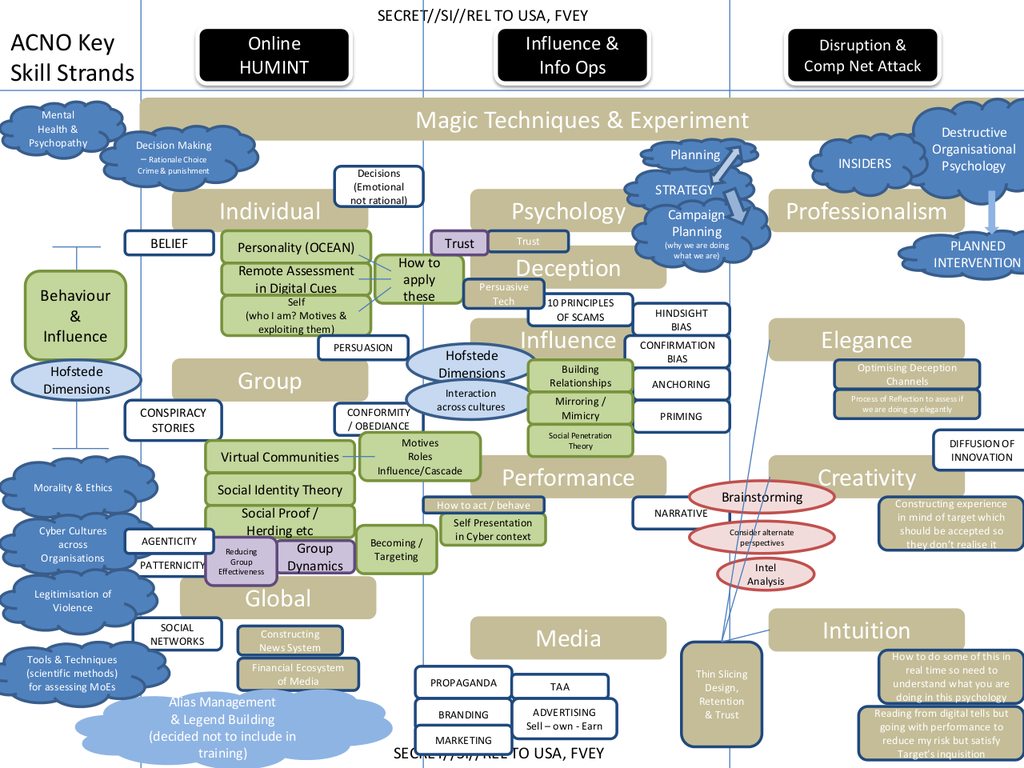
Read the deck in the original, because it is not coy. Greenwald summarizes JTRIG’s two self-identified core purposes as: “(1) to inject all sorts of false material onto the internet in order to destroy the reputation of its targets; and (2) to use social sciences and other techniques to manipulate online discourse and activism to generate outcomes it considers desirable.” The named tactics include false flag operations — posting material and falsely attributing it to someone else — fake victim blog posts, honey traps, destructive viruses, and posting “negative information” on forums. There is a “Human Science Operations Cell” devoted to “online human intelligence” and “strategic influence and disruption,” and slides on exploiting hindsight bias, confirmation bias, anchoring and priming.
And this is the passage I put in front of anyone who tells me I am being paranoid: GCHQ’s own title page acknowledges that it is “pushing the boundaries” by aiming these techniques at people who have nothing to do with terrorism or national security threats.
TABLE 2 — THE JTRIG PLAYBOOK, AND WHAT EACH MOVE IS DESIGNED TO ACCOMPLISH
Named Tactic Mechanism Effect on the Researcher Reputation destruction Deliberate publication of false material about the target, including messages to family, friends, and professional colleagues Isolation; loss of standing; the target spends his energy on defence rather than research False-flag posting Material posted to the internet and falsely attributed to the target The target’s own record becomes unreliable evidence against him Fake victim blog posts An operative poses as a person the target has supposedly wronged Manufactured grievance that no rebuttal can fully clear Honey traps Luring the target into a compromising situation, online or physical Blackmail material; permanent leverage Infiltration & synthetic consensus Multiple accounts creating the appearance that the target’s position is universally rejected by peers Bystanders conclude the evidence has been refuted, though it has not been addressed The Four D’s Deny · Disrupt · Degrade · Deceive — the stated operating framework Not persuasion. Attrition.
VIDEO EXHIBIT D “Online Government Trolls Have Infiltrated the Internet” (approx. 4:30)
https://rumble.com/v6ztjoy-online-government-trolls-have-infiltrated-the-internet.html
Timestamped Bullet Point Summary of Government Online Manipulation Operations:
• Cass Sunstein’s Cognitive Infiltration Strategy[00:00] The video begins by explaining how Cass Sunstein’s recommendations for the government to “cognitively infiltrate conspiracy theory groups online with government propaganda” were implemented by DARPA (Defense Advanced Research Projects Agency).• DARPA’s Social Media Strategic Communication Program[00:17] In 2011, DARPA unveiled its social media and strategic communication program, soliciting proposals for “innovative research” and “emerging technologies” to improve methods of detecting and conducting propaganda campaigns on social media platforms.• Official Government Propaganda Objectives[00:35] DARPA seeks to develop tools to identify “misinformation or deception campaigns” and counter them with “truthful information,” while reducing adversaries’ ability to manipulate events – essentially requesting new technologies to carry out Sunstein’s cognitive infiltration strategy.• Global Government xxxxx Operations[00:53] The concept of manipulating public opinion with online propaganda is a common tactic practiced worldwide: Israel pays college students to promote Zionist agenda, China pays commenters to spin bad news, Russia has xxxxx armies, and even Canada participates.• Edward Snowden’s GCHQ Document Leaks[01:26] In 2014, NSA whistleblower Edward Snowden leaked documents to Glenn Greenwald revealing presentation slides from the UK’s Government Communications Headquarters (GCHQ), the British equivalent of the NSA.• Joint Threat Research Intelligence Group (JTRIG)[01:41] The leaked documents expose a previously secret unit called JTRIG that has been “systematically attempting to control, infiltrate, manipulate and warp online discourse” through covert operations.• “The Art of Deception” Training Manual[01:57] The leaked document is titled “The Art of Deception: Training for Online Covert Operations,” providing internal government memos on how to conduct online manipulation campaigns.• Five Eyes Intelligence Cooperation[02:10] The Five Eyes alliance (US, Britain, New Zealand, Australia, and Canada) share intelligence and coordinate these operations, allowing them to circumvent domestic laws by having partner nations conduct operations they cannot legally perform themselves.• Online Covert Action Techniques[02:44] The documents detail various means to engage in “influence and info ops” as well as “disruption and computer net attack,” using online techniques to make things happen in both the real and cyber worlds.• The Four D’s Strategy[02:55] GCHQ’s online covert action operates under “The Four D’s”: Deny, Disrupt, Degrade, and Deceive – a comprehensive framework for manipulating online discourse and public opinion.• Psychological Manipulation Tactics[03:09] The documents dissect how human beings can be manipulated using “leaders, trust, obedience and compliance,” essentially providing a manual on how to get people to submit to authority.• Media Leader Compliance Strategy[03:17] A key tactic involves getting “trusted leaders in the media” to support government positions, telling the public “no, no, this is right. The government is right. Now everybody comply.”• Conspiracy Story Planting Operations[03:28] The leaked slides show government agents deliberately plant “conspiracy stories” online as part of their manipulation campaigns, using false narratives to discredit legitimate concerns.• Cognitive Bias Exploitation[03:35] The documents detail exploitation of psychological vulnerabilities including “hindsight bias, confirmation bias, anchoring and priming,” using these tactics to make people believe false information by confirming existing biases.• Acknowledged Propaganda Operations[03:48] The manual explicitly acknowledges they are conducting “propaganda, branding, marketing” operations, with government agents knowingly spreading propaganda through media channels.• Social Network Manipulation[03:57] The strategy involves using “compliance, obedience, and social networks” to spread government messaging, leveraging social pressure and authority figures to influence public opinion.• Propaganda Manual Revelation[04:06] The presenter emphasizes this represents a complete “Propaganda 101 manual” that reveals exactly what the government is doing to manipulate online discourse and public perception.• Recognition of Government Manipulation[04:13] The video concludes by encouraging viewers to recognize these tactics when they encounter them online, now that the government’s methods have been exposed through the leaked documents.• Big Brother Surveillance State Warning[04:21] The presenter warns that “Big Brother is here” and has developed “unbelievable propaganda” capabilities, representing a significant threat to free discourse and independent thought.
ARTICLE & DOCUMENT EXHIBIT E Greenwald, “How Covert Agents Infiltrate the Internet …” (Feb. 24, 2014) and the JTRIG deck
https://theintercept.com/2014/02/24/jtrig-manipulation/
https://theintercept.com/document/art-deception-training-new-generation-online-covert-operations/The scale — and a heresy about it
Dana Priest and William Arkin’s “Top Secret America” survey for The Washington Post found roughly 854,000 people holding Top Secret clearances across some 10,000 locations, with about a third of those clearances held by private contractors. Add to that the Five Eyes arrangement — the United States, United Kingdom, Canada, Australia and New Zealand — under which allied services routinely do at home what a partner’s charter forbids it to do in its own country. The CIA is nominally barred from domestic operations. Its four English-speaking partners are not barred from operating here at all.
Now the heresy, and I offer it because I think it is important and because it cuts against the grandiosity that this subject invites. During my first research forays into the radical left in the early 1990s — the socialist organizations in Salt Lake City, their meetings, their audiences — my honest impression was that a startling share of the people in those rooms were undercover federal agents. If that impression was even half right, the implication is not that those tiny organizations were dangerous. The implication is that an apparatus with effectively unlimited resources will generate activity to fill the budget it has been given.
Which means that some — perhaps much — of the covert attention paid to people like us is not paid because we constitute a genuine threat to national security. It is paid because the line item exists and must be justified. I find this more disturbing than the alternative, not less. A machine that targets you because you matter can be reasoned with. A machine that targets you because it has payroll to spend cannot.
IV. What Comes Next in This Series
That is the machinery, and every element of it is on the public record under a government letterhead or an author’s byline. Nothing in this installment required me to tell you a single thing about myself. That was deliberate: I wanted the doctrine on the table before the anecdote, so that when the anecdote comes you can measure it against something other than my say-so.
Part II is that anecdote, and it is the part of this that I have never set down in full for anyone. It is about a student organization I founded, a stranger who walked into a billiards club in Murray, Utah and opened with the exact philosophy that organization was built on, a five-hour conversation, a business card reading “family therapist,” and what my father’s first cousins told me about that man years later. It is also about a keylogger in 2016, an account presenting as a beautiful woman that changed its story under questioning and volunteered that stranger’s name, and three copyright strikes filed 180 seconds apart in April 2025 that destroyed a decade of work. Part III takes up what all of this cost a journalist named Gary Webb, who made his evidence accessible to the masses and paid the ultimate price for it — and closes with a field manual for recognizing, in real time, what is being done to you.
More in a day or two.
Keven
J. Keven Hofeling, Esq. (Retired) • Sunday, August 23, 2026 • Salt Lake City, Utah • http://www.jkhofelinglaw.org/
Sources for Part I (Hyperlinked)
PART I OF III • “A SPECTRE IS HAUNTING THE JFKA RESEARCH COMMUNITY” • NEXT: PART II — MY OWN ACCOUNT


Regards the above post…All I can say is “WOW!”

J. KEVEN HOFELING, ESQ.
JFK ASSASSINATION RESEARCH • DISTRIBUTION LIST WORK PRODUCT
Salt Lake City, Utah · j.keven.jd@jkhofelinglaw.org · https://jkhofelinglaw.org/
A SPECTRE IS HAUNTING THE JFKA RESEARCH COMMUNITY
— A RESPONSE IN THREE PARTS — PART II OF III
My Own Account
A Billiards Room in Murray, a Keylogger in 2016, and Three Copyright Strikes in 180 Seconds
J. KEVEN HOFELING, ESQ. • AUGUST 2026
| THIS SERIES
Part I — The Apparatus and Its Published Doctrine Part II — My Own Account (this installment) Part III — The Ultimate Price, and a Field Manual Each part stands alone; together they answer the whole question. The three installments are being circulated a day apart. |
| CONTENTS OF PART II
I. The Inner-Direct Sect, and How I Believe I Got Onto a List II. Lee Lassiter: Anatomy of a Recruitment Approach III. The Quiet Years — and a Professor Whose Father Took General Smedley Butler’s Call IV. 2016: The Keylogger, and the “Beautiful Woman” Who Was Not V. Deplatformed: What Modern Harassment Actually Looks Like VI. What Comes Next in This Series Sources for Part II (Hyperlinked) |
| WHERE WE ARE, AND A NOTE ON THE EXHIBITS
Part I put the machinery on the table without asking you to take my word for anything: Dispatch 1035-960 and the Church Committee’s Book III from the analog era; Sunstein and Vermeule’s “cognitive infiltration,” DARPA’s SMISC solicitation, and the GCHQ JTRIG deck from the digital one; and the observation that the whole apparatus has been outsourced to contractors and platforms until it is perfectly deniable. This installment is the other half — my own account, measured against that doctrine. Because a personal account is only as good as what stands behind it, I have documented this one. Four biographical exhibits accompany this installment, and each is reproduced in full rather than described: the 1990 constitution of the organization I founded, the student newspaper’s contemporaneous report of the debate I organized, the biographical record of the professor who advised my law school chapter of the National Lawyers Guild, and the credentials of the two men who corroborated the central episode. Where a detail of my story matches a technique named in a document Part I cited, I say so and give you the citation; where it rests on my word alone, I say that too, and mark it. |
I. The Inner-Direct Sect, and How I Believe I Got Onto a List
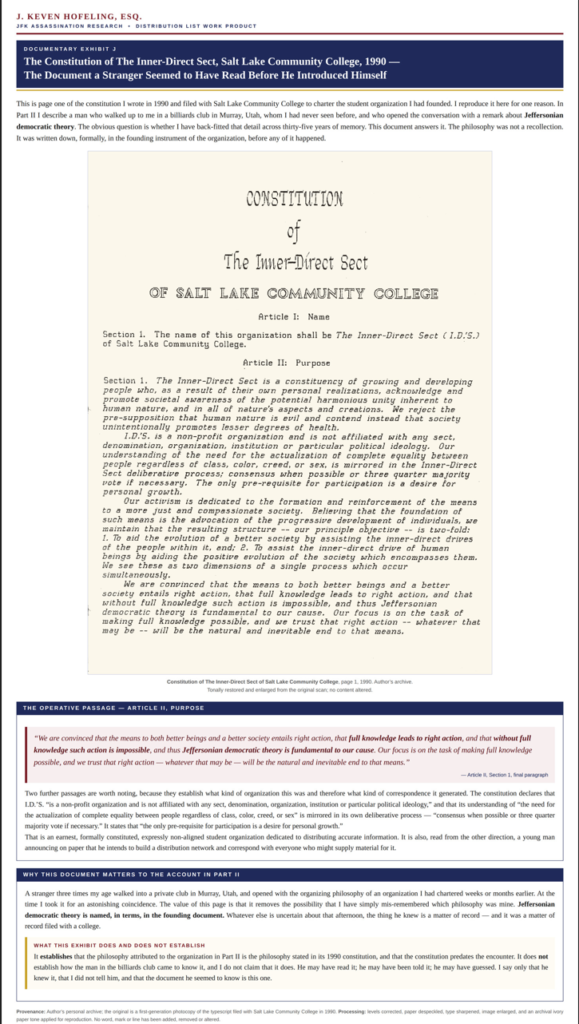
At about the time I began college I founded a progressive student organization I named The Inner-Direct Sect — the IDs — after Abraham Maslow’s work on the innate drive that carries a person up through the hierarchy of motives toward self-actualization. I wrote its constitution in 1990 and filed it with Salt Lake Community College, and because that document turns out to matter a great deal to what follows, I reproduce its first page as Exhibit J rather than paraphrase it.
The constitution states the organization’s philosophy in terms. Article II, Section 1 closes:
| “We are convinced that the means to both better beings and a better society entails right action, that full knowledge leads to right action, and that without full knowledge such action is impossible, and thus Jeffersonian democratic theory is fundamental to our cause. Our focus is on the task of making full knowledge possible, and we trust that right action — whatever that may be — will be the natural and inevitable end to that means.”
— Constitution of The Inner-Direct Sect of Salt Lake Community College, Article II, § 1 (1990) |
The same article declares that the IDs “is a non-profit organization and is not affiliated with any sect, denomination, organization, institution or particular political ideology,” that its commitment to “complete equality between people regardless of class, color, creed, or sex” is mirrored in its own deliberative process — “consensus when possible or three quarter majority vote if necessary” — and that “the only pre-requisite for participation is a desire for personal growth.” It is an earnest document. It is also, read from the other direction, a twenty-one-year-old announcing on paper that he intends to build an information distribution network.
| DOCUMENTARY EXHIBIT J
Constitution of The Inner-Direct Sect, Salt Lake Community College, 1990 — page 1 The founding instrument, in which Jeffersonian democratic theory is named as the organization’s governing philosophy. The operative paragraph is the last one on the page. Its significance is taken up in § II below. First-generation photocopy of the 1990 typescript. Tonally restored and enlarged; no content altered.
|
The mission followed from the premise. If right action requires full knowledge, the work is to distribute accurate information about the actual political realities of the United States and the world, and to stage events that put those realities in front of people. The most visible of those events was a panel debate on the Persian Gulf crisis, held on November 27, 1990, at which United States Representative Howard C. Nielson (R-Utah, 3rd Dist., 1983–1991) defended the American deployment.
In preparing for it I had studied, and spoke to a congressional aide about Ambassador April Glaspie’s July 25, 1990 meeting with Saddam Hussein — the meeting at which Glaspie said “the United States has no opinion on Arab-Arab conflicts, like your border disagreement with Kuwait” (transcript) — which by any fair reading was the green light for the invasion that became the pretext for the war.
The student newspaper, Horizon, reported the debate a week later under the headline “Debate on the Persian Gulf spurs controversy,” and I reproduce that page as Exhibit F. Its caption to the panel photograph reads: “Bill Wright, Marvin Hamilton, Kevin Hofeling and Bruce Plenk claimed the United States should not be in the Persian Gulf.” A second caption records that “Former Congressman Howard Nielson (far left) defended the United States in the Persian Gulf” — the paper was three weeks early with the word former, since Nielson had declined to seek re-election that November but sat in the House until January 3, 1991 — and a third notes that the discussion “erupted into a shouting match between the panel and SLCC students.” I am named there as Kevin; the paper spelled it with an i.
| BIOGRAPHICAL EXHIBIT F
Horizon, December 5, 1990, page 3 — “Debate on the Persian Gulf spurs controversy” The full news page, by contributing writer Jonathan D. Kline, reporting the debate of November 27, 1990. Three photographs: the panel, the audience, and the room. Reproduce the page whole — the captions are the evidentiary part. Horizon (Salt Lake Community College student newspaper), December 5, 1990, page 3. Author’s archive.
|

And to find the best material to distribute, I did something that in hindsight was consequential: I wrote to every progressive organization in the country I could identify — socialist, communist, Quaker, antiwar, civil liberties — requesting their literature. Most of them wrote back. Most of them sent material.
So: a college student in Utah, with an easily indexed surname, receiving correspondence over a year or two from essentially the entire American radical left, while chartering an organization whose constitution announced that its purpose was “making full knowledge possible,” and staging public events at which he demonstrated to a former Congressman’s face that he had read the Glaspie transcript. I have come to believe that this correspondence — not anything I said, and certainly not anything I was capable of doing — is what put me on the radar of whatever organization now performs the function COINTELPRO used to perform. There is nothing exotic in the supposition. Mail covers were standard practice. The Bureau’s files on the New Left are full of nothing more incriminating than mailing lists.
II. Lee Lassiter: Anatomy of a Recruitment Approach
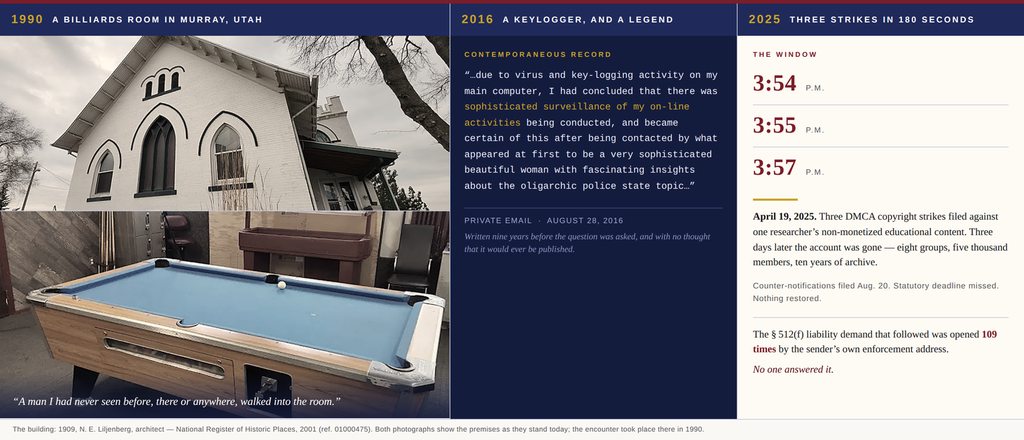
Shortly after I founded the IDs — and shortly after that page in Horizon — I was practicing billiards alone at a private club near my home that I frequented regularly. A man I had never seen before, there or anywhere, walked into the room. He was perhaps in his late fifties. He was alone. He came directly to me.
Almost immediately he made a remark to me about Jeffersonian democratic theory.
I want to sit on that sentence for a moment, because everything else follows from it. I was a twenty-one-year old in a pool hall in Murray, Utah. A stranger three times my age walked in and opened with the organizing philosophy of an organization I had chartered weeks earlier. At the time I registered it as an astonishing coincidence. I no longer think it was one.
| WHY EXHIBIT J IS IN THIS INSTALLMENT
The fair objection to that paragraph is that I am a man in his late fifties reconstructing a conversation from his teens, and that memory obligingly supplies whatever the story needs. So I have put the answer in front of you rather than asking for the benefit of the doubt. The philosophy is not a recollection. It is a written instrument. Exhibit J is the 1990 constitution, filed with a college, naming Jeffersonian democratic theory as the organization’s governing idea — and it predates the encounter. That exhibit establishes what the man knew. It does not establish how he came to know it, and I do not claim that it does. He may have read it; he may have been told it; he may have guessed. I say only that he knew it, that I had not told him, and that what he knew is on paper. |
He gave his name as Lee Lassiter. What followed was a conversation of roughly five hours, and its shape was textbook. He did most of the talking, and what he talked about was himself — a biography offered up unprompted and in remarkable detail to a stranger. He had been romantically involved with a woman connected to the Swedish royal family. The relationship had become the subject of a CIA operation against them. He had sought help from Utah’s United States Senators, Orrin Hatch and Jake Garn, and gotten nowhere. He had then approached a communist-oriented student organization at the University of Utah to help him expose the Agency’s skullduggery.
Consider what that story does. In the space of an hour it establishes the teller as (a) a man with intimate knowledge of CIA operations, (b) a victim of them, (c) someone who found the official channels useless, and (d) someone comfortable with the radical left. It is a rapport-building legend calibrated with some precision for the person I was.
Having established that, he asked about me. And I told him everything — about the IDs, the correspondence, the organizations, what I was trying to build. I was young, I was flattered, and he was an extraordinarily good listener. Then came the offers, in sequence: he was very impressed by what I was accomplishing at my age; he would like to take me to Washington, D.C., to introduce me to important people who could help me accomplish my goals; he was prepared to buy me an airline ticket almost immediately; and he had a wife much younger than himself who was “very lonely,” whom he wanted me to meet before we departed.
His business card identified him as a family therapist.
He also mentioned, in passing, that he had grown up with local members of the Hofeling family I had never met. I would learn later that they were my father’s first cousins.
TABLE 3 — THE FIVE MOVES OF THE APPROACH, AND THEIR DOCUMENTED COUNTERPARTS
| What Happened in the Billiards Room | Its Function | Where the Technique Appears in the Public Record |
|---|---|---|
| Opened with the exact organizing philosophy of an organization I had chartered weeks earlier — the philosophy named in Exhibit J | Demonstrates prior knowledge of the target while appearing to be affinity | Standard rapport-building on a briefed target profile |
| Volunteered a five-hour biography establishing CIA bona fides and victimhood at the Agency’s hands | Controlled disclosure — places the approaching officer on the target’s own side of the line | The “ideological mirror”; cf. JTRIG’s infiltration slides on trust and compliance (Part I) |
| Immediate, high-cost inducement (a paid trip to Washington, on the day of meeting) | Short-circuits deliberation; creates obligation before assessment | Classic recruitment dangle |
| Proffered introduction to a “very lonely” young wife | Compromise opportunity generating durable leverage | “Set up a honey-trap” is the first line of the JTRIG “Discredit a target” slide — Exhibit E, Part I |
| Business card reading “family therapist” | Professional cover with clinical access to the target’s psychology | The MK-ULTRA record (Joint Senate Hearing, Aug. 3, 1977) is largely a record of clinicians |
What I already knew, standing there
I was not a blank slate. By that age I had read the accounts of Sirhan Sirhan’s condition at the time he purportedly assassinated Senator Robert F. Kennedy — the amnesia, the automatic writing, the trance-state findings — and everything then publicly available about MK-ULTRA following the 1977 Senate hearings. And I had read the accounts of progressive activists who suspected that colleagues had been “co-opted” somehow before abruptly changing sides and becoming advocates for positions they had spent years opposing. The example on everyone’s mind in this community is Gary Mack, who arrived as a critic — he identified the acoustic evidence and coined “badge man” — and who became, as archivist and then curator of the Sixth Floor Museum, one of the most quoted institutional defenders of the lone-gunman position in the United States. I make no claim to know how that happened. I note only that it happened, that it happened in roughly this same period, and that it was exactly the sort of thing JFK assassination researchers like myself had learned to watch for.
The break, and the corroboration
During a break in the conversation I went and found my father and told him the whole story. I said I suspected the man was somehow associated with the CIA and was trying to co-opt me. My father told me I was “crazy” and letting my imagination get the best of me.
I went back to the club. Lassiter was still there — he had waited — and was still pressing me to agree to fly to Washington. I told him to his face that I believed he was associated with the CIA and was attempting to co-opt me, and I walked out. I never spoke to him again. Twice in the following weeks I saw him on my college campus, walking toward me between classes. Both times I walked past him as though I had not seen him.
Years later — undergraduate degree finished, law school finished, practice underway — I met my father’s first cousins, Thomas Dale Hofeling and Marvin Blaine Hofeling, and told them the story. They confirmed without hesitation that they had grown up with Lee Lassiter in Murray, Utah, and characterized him as “a strange duck.” They knew nothing about his supposed involvement with the Swedish royal family. But they told me two things I had not asked about: that Lassiter had for years run a business requiring a great deal of international travel; and that during that period Lassiter had told them the CIA regularly interviewed him about those travels.
The weight of that corroboration depends on who those two men were, so I have set out their credentials as Exhibit K rather than asking you to take “my father’s cousins” on trust. Tom Hofeling was a Korean War veteran of the United States Air Force, a teacher and counselor, president of a credit union for over thirty years — and an appointed Justice of the Peace. He sat in judgment on people professionally. Blaine Hofeling took his J.D. from the University of Utah College of Law in 1964, working the graveyard shift with the Salt Lake City Police Department while he did it, and spent his career as a risk manager at Utah Power & Light before teaching Business Law at the University of Utah for fifteen years. He was also the family’s historian, and the reason I can state with confidence who my father’s first cousins were and who their childhood neighbors in Murray were.
In other words: a judicial officer whose particular gift was the assessment of character, and a lawyer and professional risk analyst who had worked alongside a police department. Neither had any interest in the story. Neither knew what I was about to ask. Both volunteered the detail about the Agency’s interviews without being asked for it.
| BIOGRAPHICAL EXHIBIT K
The men who corroborated the Lassiter account — Thomas Dale Hofeling, Marvin Blaine Hofeling, and Steven Lee Payton Portraits and credentials of the two corroborating witnesses, together with the mentor their judgment produced. Tom Hofeling identified a young Assistant Utah Attorney General named Steven Lee Payton as a man of exceptional integrity in the late 1970s and brought him into the family; Tom and Blaine later asked Payton to mentor me. Photographs and family account: https://jkhofelinglaw.org/tribute
|
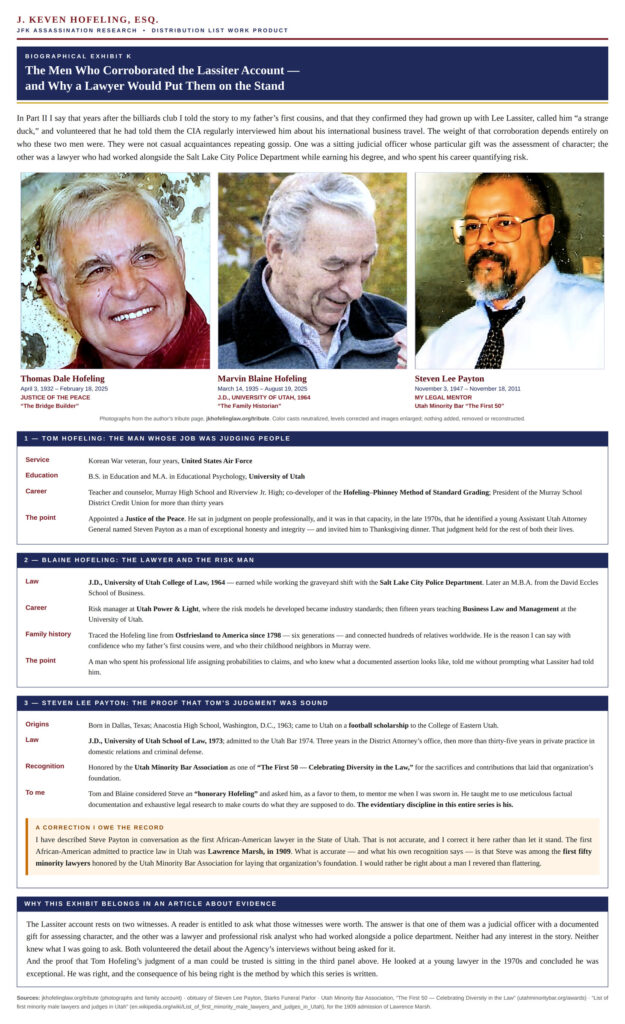
Let me be precise about what that is and is not. It is not proof that Lee Lassiter was a CIA officer, and I have never said he was. Debriefing returning American businessmen was routine, systematic and entirely lawful Agency practice — it was the Domestic Contact Service’s whole function. What the cousins’ account establishes is that the man who walked up to me was, on his own telling to his own childhood friends, a person in an ongoing reporting relationship with the Central Intelligence Agency. That is a materially different thing from a coincidence in a pool hall.
| WHAT I TAKE FROM IT
I do not read the Lassiter episode as evidence that I was particularly important to anyone. I read it as the opposite. I read it as an indication of how routine and how industrialized the procedure is — that a twenty-one-year-old in Utah with a mailing list and a mimeograph was worth five hours of a man’s afternoon and the price of a plane ticket. You do not spend that on people you consider important. You spend it on people you are processing. And I have wondered for thirty years what my adult life would have looked like had I said yes. Would I have been hypnotized by Lee Lassiter, the family therapist? Would something involving me and his lonely young wife have been recorded for later use? I cannot answer those questions. I can only note that both offers on the table that afternoon map, with uncomfortable precision, onto techniques the record shows were in actual use — one of them word for word onto a GCHQ slide reproduced in Part I. |
My honest belief is that a great many progressive activists — and a great many conspiracy and JFKA researchers — have been co-opted by the techniques I watched deployed that day. And I believe it goes some distance toward explaining a thing that otherwise makes no sense: why certain genuinely brilliant researchers — as well as a large number who are not the sharpest knives in the drawer — will advocate and disseminate positions on political crimes that are wholly unsupported by evidence, and will remain immune to legitimate and probative evidence no matter how many times it is put in front of them.
III. The Quiet Years — and a Professor Whose Father Took Smedley Butler’s Call
Here is a data point that cuts against my own thesis, and I include it because a brief that suppresses the contrary evidence is not worth reading.
My impression is that the deep state left me entirely alone while I was in law school. That is so even though I founded a chapter of the National Lawyers Guild there — an organization that was itself a COINTELPRO target for decades — and even though I continued, as I had at my undergraduate universities, to write weekly and radically progressive columns for the student newspaper, the Northern Review.
My faculty advisor for that Guild chapter was Constitutional Law Professor Bruce Comly French — and here the history in this series folds back on itself in a way I have never gotten over. Professor French joined the Claude W. Pettit College of Law at Ohio Northern University in 1978 and taught there for more than thirty years; the law school has since renamed its Inns of Court in his honor after he died on July 29, 2025.
He was the son of Paul Comly French (1903–1960), the Philadelphia Quaker journalist who wrote for the Philadelphia Record and the New York Post — and who was the reporter to whom Major General Smedley D. Butler, twice awarded the Medal of Honor, disclosed what is now called the Business Plot. On September 13, 1934, French met the bond salesman Gerald C. MacGuire at 52 Broadway and put the plot on the record; he broke the story on November 21, 1934; and he testified before the House Special Committee on Un-American Activities — the McCormack–Dickstein Committee — which reported on February 15, 1935 that it “was able to verify all the pertinent statements made by General Butler.” No one was prosecuted.
So the man who supervised my first act of organized legal dissent was raised by the journalist through whom an attempted corporate coup against an American president was blown open — and the mainstream press of the day treated it as a joke. That is a lesson about American journalism which has not needed revising since, and which Part III will show being taught again, sixty years later, to Gary Webb. Exhibit I sets out the documentary chain, and marks plainly which link rests on my word alone.
| BIOGRAPHICAL EXHIBIT I
Professor Bruce Comly French of Ohio Northern University — and his father, the reporter to whom General Smedley Butler disclosed the 1934 plot against Roosevelt The documentary chain: French’s ONU appointments and the Inns of Court named for him; his parentage; his father’s 1934 meeting with MacGuire, the November 21 exposé, the sworn testimony, and the Committee’s verified finding. The exhibit distinguishes the four propositions established by public record from the one — that Professor French advised my Guild chapter — that rests on my own first-hand account. Biographical entry for Bruce Comly French; obituary, The Lima News (2025); Ohio Northern University Claude W. Pettit College of Law.
|
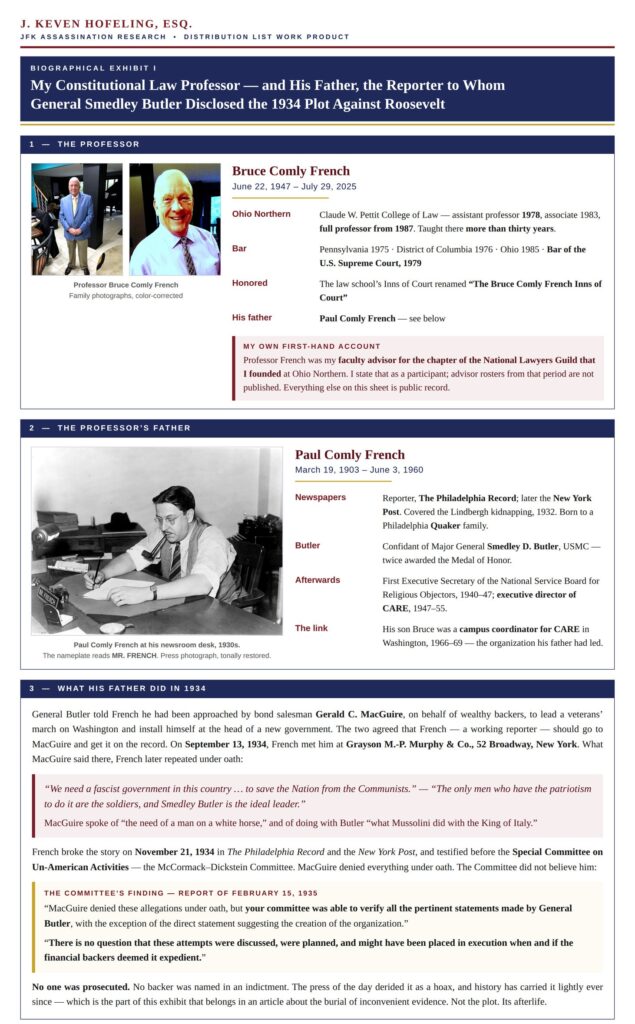
Then, for the first twenty years of my legal career, nothing. I was too busy establishing a law firm and litigating civil and criminal cases to do much political activism, although I continued to monitor the assassination research websites — the old Usenet groups, as well as the the Education Forum — as I had since their advent in the early days of the internet.
I do not think that quiet was an accident, and I do not think it was a reprieve. I think it is exactly what the model predicts. A young organizer building a distribution network is a target. A lawyer with a docket and two children is not. The apparatus is not interested in your opinions. It is interested in your reach. When my reach went to zero, so did the attention. When my reach came back, so did the attention — and it came back with thirty years of new tools.
IV. 2016: The Keylogger, and the “Beautiful Woman” Who Was Not
In the last decade of my practice I finally had time to build again, and I founded two Facebook groups: the Democratic Social Justice & Truth group on progressive politics, and the Political Assassinations Research Group on the political assassinations of the 1960s, principally President Kennedy’s. On the first of these I posted extensively about the enabling legislation for U.S. intelligence propaganda and false-flag operations directed at the American public, always citing the statutes and the primary-source record.
Within weeks my main computer exhibited virus activity and keylogging behavior. Then came the contact. What follows is not a reconstruction; it is what I wrote, contemporaneously, in a private email to a single friend on August 28, 2016 — a decade before you asked your question, Robert, and with no thought that it would ever be published:
| “In the last month, due to virus and key-logging activity on my main computer, I had concluded that there was sophisticated surveillance of my on-line activities being conducted, and became certain of this after being contacted by what appeared at first to be a very sophisticated beautiful woman with fascinating insights about the oligarchic police state topic but who, upon my questioning about some inconsistencies between her profile details and statements, altered the operational legend to provide that his profile photographs are actually of a female model, and that he has a background that allowed him to be present at U.S. embassies to photograph the embassy in Iran being taken over during the 1979 Islamic revolution, the signing of the mid-east peace accords, the assassination of Sadat, and the invasion of Panama … He also claimed to know Lee Lassiter, who was the first mysterious person who contacted me out of this world of shadows shortly after I made discernible waves by organizing a debate at SLCC about the first Iraq war which included U.S. Congressman Howard Nielson …”
— J. Keven Hofeling, contemporaneous email, August 28, 2016 (preserved in the author’s records) |
I want to draw out three features of that account, because each of them is corroborated by material that was published before I wrote it — the material set out in Part I — and that I was not thinking about when I did.
| 1. | The honey-trap legend. A “beautiful woman” profile with unusually sophisticated command of the exact subject matter I was posting on. The JTRIG deck names this. Greenwald published it in February 2014. |
| 2. | The pivot to a second legend when the first was compromised. When I probed the inconsistencies, the account did not go dark — it produced a new and more flattering biography built around intelligence-adjacent presence at Tehran, Camp David, Sadat’s assassination, and Panama. That is not what a catfisher does. A catfisher blocks you. |
| 3. | The name-drop. He claimed to know Lee Lassiter — a name that appears nowhere in my public writing, that belonged to a five-hour conversation in a Utah billiards club roughly twenty-five years earlier, and that functions in this exchange the way a handler’s name functions: as proof of bona fides. |
And there is a fourth feature, which I set down here with some reluctance, because it is the hinge between my story and the story that closes this series. In that same 2016 email, having concluded I was under surveillance, I wrote that I believed I could “disappear or have an accident at any time,” and I asked one specific thing of my friend:
| “I certainly would not want it to appear to be a suicide because of the effect that would have on my children.”
— J. Keven Hofeling, private email, August 28, 2016 |
Hold that sentence. I will come back to it in Part III.
V. Deplatformed: What Modern Harassment Actually Looks Like
Now to the part of my answer that is neither recollection nor inference, but paper. This is what harassment of a researcher looks like in 2025. It does not require a warrant, a wiretap, or a burglary. It requires three form submissions and a corporation willing to send them.
Across roughly ten years on Facebook I successfully appealed over 200 DMCA takedowns and administrative penalties against non-monetized educational and political content, and survived them. Then, in 2025 — as I posted more and more about the CIA origins of the Ukraine war and the Israeli genocide in Gaza — the platform finally succeeded, on copyright grounds, by the simple expedient of ignoring my appeals and counter-notifications.
TABLE 4 — THE 2025 CROSS-PLATFORM SEQUENCE
| Date | Actor | Action |
|---|---|---|
| Apr. 19, 2025 — 3:54, 3:55 and 3:57 p.m. | Paramount Global → Meta | Three DMCA copyright strikes filed inside a 180-second window against non-monetized educational content (report nos. 654305147465426; 2131121730672040; 1187486633160179) |
| Apr. 22, 2025 | Meta / Facebook | Termination of a ten-year account (facebook.com/HOFELINGlawKEVEN), destroying eight groups and access to more than 5,000 members, ten years of research archive, and a decade of family genealogical records |
| May–Jul. 2025 | Alphabet / YouTube | Successive copyright strikes; channel terminated July 23, 2025 after eight years in good standing |
| Aug. 4, 12 and 19, 2025 | Vimeo | Three videos removed; the paid account terminated on the day of the third removal |
| Aug. 20, 2025 | Author | DMCA §512(g) counter-notifications filed |
| Sept. 5–9, 2025 | Paramount Global | Failed to file the court action the statute requires within 10–14 business days. Under 17 U.S.C. §512(g)(2)(B) the claims were forfeited. Nothing was restored. |
| Sept. 14, 2025 | Author | Formal §512(f) liability demand served on Paramount Global’s legal department and its CBS and MTV Networks copyright agents, copying Meta’s IP and appeals addresses and the Electronic Frontier Foundation |
The demand set out the law, which is not ambiguous. Three strikes inside three minutes is a coordinated attack pattern, not copyright enforcement; a sender’s subjective good faith is the standard, and the pattern defeats it (Rossi v. Motion Picture Ass’n of America, Inc., 391 F.3d 1000, 1004 (9th Cir. 2004)). A sender has an affirmative duty to consider fair use before issuing a takedown, and failure to do so is prima facie §512(f) liability for knowingly materially misrepresenting infringement (Lenz v. Universal Music Corp., 815 F.3d 1145, 1151 (9th Cir. 2016)). The material was textbook fair use — non-commercial educational and critical political commentary, brief analytical excerpts, no cognizable market effect (Campbell v. Acuff-Rose Music, Inc., 510 U.S. 569, 579 (1994)). Exposure runs to $150,000 per willful misrepresentation, plus actual damages and fees (Fogerty v. Fantasy, Inc., 510 U.S. 517, 527 (1994)).
What happened next was nothing. No retraction, from anyone, ever. But the email tracking is instructive, and I have preserved it: CBS’s online enforcement address opened that demand 109 times. Paramount’s designated agent clicked through. Meta’s IP address clicked through. And not one of them answered, retracted, or filed the action the statute required of them.
| THE POINT, FOR ROBERT’S COLLECTION
When the mechanism for silencing a researcher has been fully privatized, the government does not need to do anything at all. It needs only a takedown regime with no penalty for abuse, a platform with no obligation to adjudicate, and a rights-holder willing to press the button. The statutory remedy for bad-faith takedowns exists — I invoked it, in writing, as a lawyer, with case citations — and it did not restore a single group or a single member. That is not a system that failed. That is a system working exactly as designed. That three separate, formally competing platforms executed three parallel terminations within a ninety-day window against one researcher, immediately following publication on Gaza, Ukraine and CIA operations, is precisely the government-platform interface the Supreme Court examined in Murthy v. Missouri, 603 U.S. 43 (2024). |
VI. What Comes Next in This Series
That is my answer to the literal question you asked, Robert. No wiretap I can prove. No burglary. What I have instead is a recruitment approach at twenty-one that matches published tradecraft move for move; a corroborated CIA reporting relationship on the part of the man who made it; a keylogger and a legend-switching contact in 2016 that named him; and a documented, statutory, unremedied destruction of a decade of work in 2025. Every one of those is survivable, and I have survived all of them.
Part III is about the case that is not survivable. In 1996 a Pulitzer-sharing reporter named Gary Webb published a series in the San Jose Mercury News and did something no one had done before with that material: he put the underlying documents on the web, where anyone could check him. He made it accessible to the masses. What followed is documented not by his defenders but by the Central Intelligence Agency, in an internal history that now sits in the Agency’s own public reading room, describing with some satisfaction how the press was worked until his career was over. Eight years later he was dead of two gunshot wounds to the head, and it was ruled a suicide. Part III sets that record out, explains why I think the sentence I quoted above from my own 2016 email belongs beside it, and closes with the field manual — the one diagnostic that has never failed me for telling a genuine opponent from the other kind, and what I would ask each of you to start doing tomorrow.
More in a day or two.
Keven
J. Keven Hofeling, Esq. • Monday, August 24, 2026 • Salt Lake City, Utah • http://www.jkhofelinglaw.org/
Sources for Part II (Hyperlinked)
| Item | URL (spelled out) |
|---|---|
| Rep. Howard C. Nielson (R-Utah, 3rd Dist., 1983–1991) | https://en.wikipedia.org/wiki/Howard_C._Nielson |
| Glaspie–Hussein meeting transcript (July 25, 1990) | https://www.rapeutation.com/transcr.meeting.htm |
| Project MK-ULTRA, Joint Senate Hearing (Aug. 3, 1977) — full transcript PDF | https://www.intelligence.senate.gov/wp-content/uploads/2024/08/sites-default-files-hearings-95mkultra.pdf |
| Gary Mack — biographical entry, Spartacus Educational | https://spartacus-educational.com/JFKmack.htm |
| Paul Comly French (1903–1960) — journalist, Business Plot corroborating witness | https://en.wikipedia.org/wiki/Paul_Comly_French |
| J. Keven Hofeling, “Tribute” — Thomas Dale Hofeling, Marvin Blaine Hofeling, Steven Lee Payton | https://jkhofelinglaw.org/tribute |
| Obituary of Professor Bruce Comly French, The Lima News (July 2025) | https://www.legacy.com/us/obituaries/limaohio/name/bruce-french-obituary?id=59110033 |
| Ohio Northern University, Claude W. Pettit College of Law | https://en.wikipedia.org/wiki/Pettit_College_of_Law |
| Maj. Gen. Smedley D. Butler, USMC (1881–1940) | https://en.wikipedia.org/wiki/Smedley_Butler |
| “List of first minority male lawyers and judges in Utah” (Lawrence Marsh, admitted 1909) | https://en.wikipedia.org/wiki/List_of_first_minority_male_lawyers_and_judges_in_Utah |
| The Business Plot (1933–34) and the McCormack-Dickstein Committee | https://en.wikipedia.org/wiki/Business_Plot |
| Glenn Greenwald, “How Covert Agents Infiltrate the Internet…,” The Intercept (Feb. 24, 2014) | https://theintercept.com/2014/02/24/jtrig-manipulation/ |
| GCHQ/JTRIG, “The Art of Deception” — The Intercept document library | https://theintercept.com/document/art-deception-training-new-generation-online-covert-operations/ |
| Murthy v. Missouri, 603 U.S. 43 (2024) | https://supreme.justia.com/cases/federal/us/603/23-411/ |
| 17 U.S.C. §512 (DMCA notice, counter-notice, and §512(f) misrepresentation liability) | https://www.law.cornell.edu/uscode/text/17/512 |
| PART II OF III • “A SPECTRE IS HAUNTING THE JFKA RESEARCH COMMUNITY” • NEXT: PART III — THE ULTIMATE PRICE, AND A FIELD MANUAL |
Edited by Keven Hofeling
J. KEVEN HOFELING, ESQ.
JFK ASSASSINATION RESEARCH • DISTRIBUTION LIST WORK PRODUCT
Salt Lake City, Utah · j.keven.jd@jkhofelinglaw.org · https://jkhofelinglaw.org/
A SPECTRE IS HAUNTING THE JFKA RESEARCH COMMUNITY
— A RESPONSE IN THREE PARTS — PART I OF III
The Apparatus and Its Published Doctrine
Dispatch 1035-960, COINTELPRO, and the Continuum That Runs From Mail Covers to JTRIG
J. KEVEN HOFELING, ESQ. • AUGUST 2026
Part I — The Apparatus and Its Published Doctrine (this installment)
Part II — My Own Account
Part III — The Ultimate Price, and a Field Manual
Each part stands alone; together they answer the whole question. The three installments are being circulated a day apart.
Foreword — The Question, and the Larger Question Behind It
I. What This Is Not, and What It Is
II. Something Is Rotten in the State of Denmark
III. The Continuum: From COINTELPRO to JTRIG
IV. What Comes Next in This Series
Sources for Part I (Hyperlinked)
Foreword — The Question, and the Larger Question Behind It
Robert, thank you for asking. I have been meaning for years to set down in one place what I know from my own experience about the surveillance, co-optation, and harassment of researchers who look too closely at the criminal political events of the 1960s and their long shadow. Your inquiry on the Education Forum (Topic 32227), and Dr. Peter Dale Scott’s striking answer to it, gave me the push.
Because the answer runs long, and because Bill Simpich has fairly reminded me that my missives do, I am going to give it to you in three installments you can actually finish, a day apart. Part I, this one, sets out the apparatus and its published doctrine — what the government itself has admitted, in its own paper. Part II is my own account, from a pool hall in Murray, Utah in the early 1990s to a three-minute window in April 2025. Part III is the price — what it cost the journalist Gary Webb — and a field manual for the researcher who would rather not pay it.
But this is not only an answer to you. It is addressed, with respect and some urgency, to the far larger number of researchers who did not answer you — and to the one observation in the thread I cannot get out of my head. John Simkin, who has done more than any living person to preserve this field’s record, wrote on August 14:
— John Simkin, Education Forum, Topic 32227 (Aug. 14, 2026)
I want to take that sentence seriously, because I think it is exactly backwards — and because the fact that a man of Mr. Simkin’s stature can arrive at it is itself the best evidence for the thesis of this series. The silence in that thread is not evidence that no one is being worked on. It is the product of the work. A counterintelligence program that leaves its targets convinced they are too unimportant to be targeted has not failed. It has succeeded completely.
So: a spectre is haunting the JFKA research community. Most of us have been trained — by the movies, by the sneer that attaches to the words “paranoid” and “conspiracy theorist,” and by a great deal of patient effort on the part of people who are paid to produce that sneer — to treat clandestine political operations as a genre of entertainment rather than a documented feature of American life with a fifty-year paper trail. Meanwhile every legitimate researcher in this field is a pawn on a chess board where the stakes include the public disclosure of government crimes, the possibility of prosecution, and the shutting down of a financial gravy train without precedent in human history. Those are not small stakes. People do not leave stakes like that unattended.
What follows is my account and my evidence. I have tried to make it useful rather than merely alarming: every substantiating document, video, and archive I rely on is linked where I rely on it, and gathered again in a source table at the foot of each installment, so that the bona fide researcher who wants to get to the bottom of these matters has the underlying material in hand rather than my summary of it.
— Founding principle of the Inner-Direct Sect, ca. 1991, based upon Jeffersonian Democratic Theory
I. What This Is Not, and What It Is
Let me say at the outset what I am not claiming. I have never found a bug in my telephone. I have never come home to a jimmied door and a missing hard drive. I cannot tell you that there is a file on me, because I have not seen it, and neither has anyone else who has not seen it.
What I can tell you is narrower and, I think, more useful — because it is documented, and because it happened to me. The counterintelligence apparatus this community talks about does not spend most of its effort kicking in doors. Kicking in doors is expensive, legally exposed, and it creates martyrs. The cheap and far more effective work is done upstream: identify the person early; evaluate whether he can be turned; turn him if he can be; and if he cannot, degrade his reach and his credibility until he is talking only to himself.
That is not my theory. That is published doctrine, and I will cite it below. I believe I have been on the receiving end of both halves of the sequence — the recruitment approach as a very young man, and the reach-degradation as an old one. That is Part II’s business. This installment establishes that the machinery I say was pointed at me exists, is admitted, and is still running.
II. Something Is Rotten in the State of Denmark
I read David S. Lifton’s Best Evidence (Macmillan, 1980) when I was fourteen years old, in the early 1980s. It did to me what it did to a great many people: it moved the assassination out of the category of history and into the category of evidence. Once you understand that the medical evidence is where this case actually lives, and that the medical evidence does not say what the Warren Report says it says, you cannot go back.
From there I read everything I could locate — and what I found alongside the assassination literature was a second literature: the record of what the intelligence agencies had done to the people who investigated the first one. By my late teens I was subscribing to The Nation, Mother Jones, and The Progressive, which is an unusual reading list for a teenager in Murray, Utah, and which is precisely the point I will return to in Part II.
Two documents from that period matter for everything that follows, and both are now beyond dispute.
The first is CIA Dispatch 1035-960, “Countering Criticism of the Warren Report,” dated 1 April 1967 — the Agency’s own instruction to its stations, released under FOIA in 1976 and archived at History Matters as RIF 104-10406-10110. It directs officers “to discuss the publicity problem with … friendly elite contacts (especially politicians and editors),” and “to employ propaganda assets to [negate] and refute the attacks of the critics,” noting that “[b]ook reviews and feature articles are particularly appropriate for this purpose.” It further instructs that critics be answered with the suggestion that “parts of the conspiracy talk appear to be deliberately generated by Communist propagandists.” That dispatch is the origin point of the reflex by which the phrase “conspiracy theorist” now does the work that evidence used to do.
The second is the Church Committee’s Final Report, Book III (1976) (Senate Select Committee, full PDF), which set out COINTELPRO’s stated purpose in the Bureau’s own vocabulary — to “expose, disrupt, misdirect, discredit, or otherwise neutralize” domestic political activity — and which concluded, in language every researcher in this field should have memorized, that “the Bureau conducted a sophisticated vigilante operation aimed squarely at preventing the exercise of First Amendment rights of speech and association.”
Neither of these is a theory. Both are government paper.
CIA Dispatch 1035-960 — “Countering Criticism of the Warren Report” (1 April 1967)
https://www.history-matters.com/archive/jfk/cia/russholmes/104-10406/104-10406-10110/html/104-10406-10110_0002a.htm
https://archive.org/details/CIADOC1035960
Church Committee, Final Report, Book III (1976) — COINTELPRO
https://www.intelligence.senate.gov/sites/default/files/94755_III.pdf
The dissent that wasn’t
I started college at about the time Oliver Stone’s JFK was released in December 1991. By then I knew enough of the actual record to watch the reaction with a certain grim clarity — because the most ferocious attacks on the film did not come from the right. They came from the respectable left. Alexander Cockburn devoted column after column in The Nation to demolishing Stone and the assassination critics generally, and Noam Chomsky published Rethinking Camelot (South End Press, 1993) in the same register: that it does not much matter who killed Kennedy, because Kennedy was no different from Johnson.
To a young man who had already read the autopsy evidence, this was the moment the picture came into focus. The magazines I had subscribed to precisely because they were supposed to be adversarial to the national security state were among those ones running interference for it on the single clearest case of its criminality. Something smelled rotten in Denmark.
I do not assert that Cockburn or Chomsky were assets, and I will not. I assert something I think is more interesting and better supported: the boundary-policing function described in CIA Dispatch 1035-960 does not require assets. It requires only that a respectable person’s professional standing be made to depend on his not going there. Once the Agency has spent two decades cultivating “friendly elite contacts” in the press — the practice Carl Bernstein documented at length in “The CIA and the Media,” Rolling Stone, October 20, 1977, drawing on the Church Committee’s own files — the boundary maintains itself. That is the durable meaning of what is loosely called Operation Mockingbird: not a permanent payroll, but a permanent reflex.
Mr. Simkin’s own testimony in your thread is the cleanest confirmation of this I have seen from inside the profession. He worked for The Guardian, he wrote, “the UK’s most liberal newspaper,” and “they would not publish articles that questioned the Warren Commission report.” Denise Hazelwood reported in the same thread that she was banned from Daily Kos as a “conspiracy theorist” for submitting a piece on the evidentiary anomalies. Neither of those is a wiretap. Both are the dispatch, working as designed, sixty years on.
Carl Bernstein, “The CIA and the Media,” Rolling Stone (Oct. 20, 1977)
http://www.carlbernstein.com/the-cia-and-the-media-rolling-stone-10-20-1977
III. The Continuum: From COINTELPRO to JTRIG
The mistake most researchers make is to treat COINTELPRO as history. It is not history. It is the first generation of a program that was never dismantled — only professionalized, privatized, digitized, and made deniable. The table below is the shape of the thing.
TABLE 1 — THE CONTINUUM OF DOMESTIC COUNTERINTELLIGENCE AGAINST RESEARCHERS
Analog
Transitional
Digital
The Continuum: COINTELPRO → JTRIG
The doctrine, in print, under authors’ names
In 2008, Professor Cass R. Sunstein — later Administrator of the White House Office of Information and Regulatory Affairs, and later still a member of President Obama’s NSA review panel — and Adrian Vermeule published “Conspiracy Theories”, proposing that government employ teams of covert agents and pseudo-independent advocates to “cognitively infiltrate” online groups and websites. That is not a leak and not an allegation. It is a law review paper with a byline.
In 2011, DARPA announced its Social Media in Strategic Communication (SMISC) program, soliciting research into detecting and conducting persuasion campaigns on social platforms.
In 2014, Edward Snowden’s GCHQ material was published by Glenn Greenwald in The Intercept as “How Covert Agents Infiltrate the Internet to Manipulate, Deceive, and Destroy Reputations”, exposing the Joint Threat Research Intelligence Group and publishing its training deck, “The Art of Deception: Training for a New Generation of Online Covert Operations” (mirrors: ACLU; DocumentCloud #1021430).
Read the deck in the original, because it is not coy. Greenwald summarizes JTRIG’s two self-identified core purposes as: “(1) to inject all sorts of false material onto the internet in order to destroy the reputation of its targets; and (2) to use social sciences and other techniques to manipulate online discourse and activism to generate outcomes it considers desirable.” The named tactics include false flag operations — posting material and falsely attributing it to someone else — fake victim blog posts, honey traps, destructive viruses, and posting “negative information” on forums. There is a “Human Science Operations Cell” devoted to “online human intelligence” and “strategic influence and disruption,” and slides on exploiting hindsight bias, confirmation bias, anchoring and priming.
And this is the passage I put in front of anyone who tells me I am being paranoid: GCHQ’s own title page acknowledges that it is “pushing the boundaries” by aiming these techniques at people who have nothing to do with terrorism or national security threats.
TABLE 2 — THE JTRIG PLAYBOOK, AND WHAT EACH MOVE IS DESIGNED TO ACCOMPLISH
“Online Government Trolls Have Infiltrated the Internet” (approx. 4:30)
https://rumble.com/v6ztjoy-online-government-trolls-have-infiltrated-the-internet.html
Timestamped Bullet Point Summary of Government Online Manipulation Operations:
Greenwald, “How Covert Agents Infiltrate the Internet …” (Feb. 24, 2014) and the JTRIG deck
https://theintercept.com/2014/02/24/jtrig-manipulation/
https://theintercept.com/document/art-deception-training-new-generation-online-covert-operations/
The scale — and a heresy about it
Dana Priest and William Arkin’s “Top Secret America” survey for The Washington Post found roughly 854,000 people holding Top Secret clearances across some 10,000 locations, with about a third of those clearances held by private contractors. Add to that the Five Eyes arrangement — the United States, United Kingdom, Canada, Australia and New Zealand — under which allied services routinely do at home what a partner’s charter forbids it to do in its own country. The CIA is nominally barred from domestic operations. Its four English-speaking partners are not barred from operating here at all.
Now the heresy, and I offer it because I think it is important and because it cuts against the grandiosity that this subject invites. During my first research forays into the radical left in the early 1990s — the socialist organizations in Salt Lake City, their meetings, their audiences — my honest impression was that a startling share of the people in those rooms were undercover federal agents. If that impression was even half right, the implication is not that those tiny organizations were dangerous. The implication is that an apparatus with effectively unlimited resources will generate activity to fill the budget it has been given.
Which means that some — perhaps much — of the covert attention paid to people like us is not paid because we constitute a genuine threat to national security. It is paid because the line item exists and must be justified. I find this more disturbing than the alternative, not less. A machine that targets you because you matter can be reasoned with. A machine that targets you because it has payroll to spend cannot.
IV. What Comes Next in This Series
That is the machinery, and every element of it is on the public record under a government letterhead or an author’s byline. Nothing in this installment required me to tell you a single thing about myself. That was deliberate: I wanted the doctrine on the table before the anecdote, so that when the anecdote comes you can measure it against something other than my say-so.
Part II is that anecdote, and it is the part of this that I have never set down in full for anyone. It is about a student organization I founded, a stranger who walked into a billiards club in Murray, Utah and opened with the exact philosophy that organization was built on, a five-hour conversation, a business card reading “family therapist,” and what my father’s first cousins told me about that man years later. It is also about a keylogger in 2016, an account presenting as a beautiful woman that changed its story under questioning and volunteered that stranger’s name, and three copyright strikes filed 180 seconds apart in April 2025 that destroyed a decade of work. Part III takes up what all of this cost a journalist named Gary Webb, who made his evidence accessible to the masses and paid the ultimate price for it — and closes with a field manual for recognizing, in real time, what is being done to you.
More in a day or two.
Keven
J. Keven Hofeling, Esq. (Retired) • Sunday, August 23, 2026 • Salt Lake City, Utah • http://www.jkhofelinglaw.org/
Sources for Part I (Hyperlinked)
Edited by Keven Hofeling