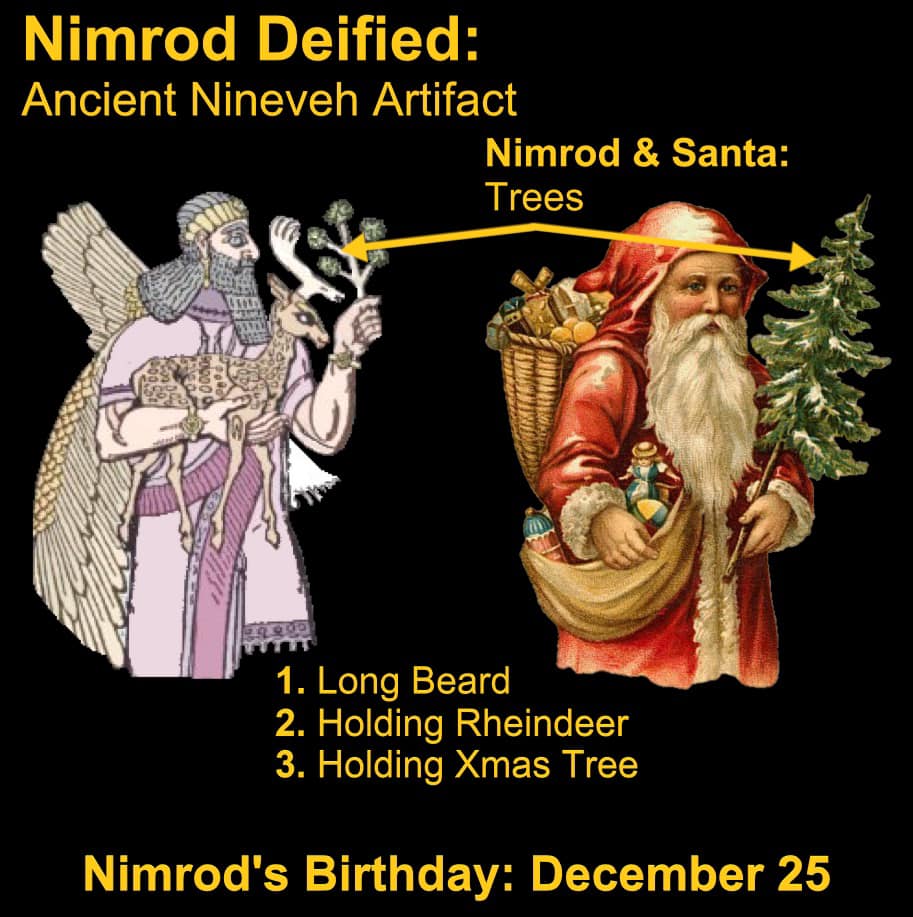
Nimrod, The Cedar Tree and the Origins of Christmas
by Ancient Epics’s Post
Nimrod, who is a prominent figure in ancient Mesopotamian lore and biblical texts, is described as a “mighty hunter before the Lord.” As the great-grandson of Noah, Nimrod’s lineage traces back to Noah’s son Ham, through Ham’s son Cush. Nimrod’s rise to power is closely tied to a pivotal conflict following the division of the earth among Noah’s descendants. According to history, Nimrod occupies and rules his territory as a descendant of Ham, the victor in a war against Shem, Noah’s other son, who lost this world war. Nimrod was a post deluvian king who’s realm included Babel, Erech, Accad, and Calneh in the land of Shinar.
This post-flood division of the world is reflected in traditions like the Sibylline Oracles, which speak of patriarchs and their governance over different regions. The text also details the eventual death of Noah and a major war between prominent figures like Cronus and Titan, which symbolically parallels the struggles between Shem and Ham’s descendants for dominion over territories and influence.
The Association Between Nimrod, December 25th, and Christmas Traditions
Some theories suggest that December 25th was originally celebrated as Nimrod’s birthday. After his death, his mother and wife, Semiramis, claimed that a full-grown evergreen tree miraculously sprang from a dead tree stump, symbolizing Nimrod’s rebirth. On the anniversary of his birth, Nimrod was believed to visit the evergreen tree and leave gifts beneath it. This narrative, while debated among scholars, is considered by some to be the origin of the Christmas tree tradition.
The Sacred Cedar Tree in Mesopotamian Mythology
The cedar tree held profound significance for the Sumerians, Babylonians, and Assyrians.
1. Mythological and Religious Importance
• The Epic of Gilgamesh
The cedar tree is central to the Epic of Gilgamesh, where Gilgamesh and Enkidu venture into the divine Cedar Forest, guarded by Humbaba. The forest is sacred to Enlil, the chief deity, and cutting down its trees represents human ambition and defiance of divine authority.
• The Anunnaki
The Anunnaki, divine architects of Mesopotamian civilization, viewed cedar trees as symbols of cosmic balance and authority. These sacred trees represented a spiritual connection between gods and humans.
2. Symbolism of the Cedar Tree
• Immortality and Wisdom
The cedar tree’s durability and resistance to decay made it a symbol of immortality. It was also seen as a source of divine wisdom, connecting the heavens, earth, and underworld.
• Cosmic Significance
In Mesopotamian religions, sacred trees, including cedars, often served as a cosmic axis (axis mundi), representing the structure of the universe and the connection between realms.
3. Practical Usage
Cedar wood was highly valued for its durability and aromatic properties, making it ideal for building temples, ziggurats, and other sacred structures.
From Sacred Tree to Christmas Tree
The symbolism of evergreen trees, including cedars, as eternal life became integrated into winter solstice traditions, influencing the Christian adaptation of the Christmas tree. The narrative of Nimrod’s rebirth and his association with an evergreen tree offers a fascinating lens through which to view these traditions.
Conclusion
Nimrod’s story, his association with December 25th, and the sacred cedar tree reflect the blending of ancient mythology, religious symbolism, and historical events. From his descent as a victor’s heir to his role in inspiring traditions that echo through millennia, Nimrod’s legacy endures as a figure bridging ancient Mesopotamian culture and modern customs.