
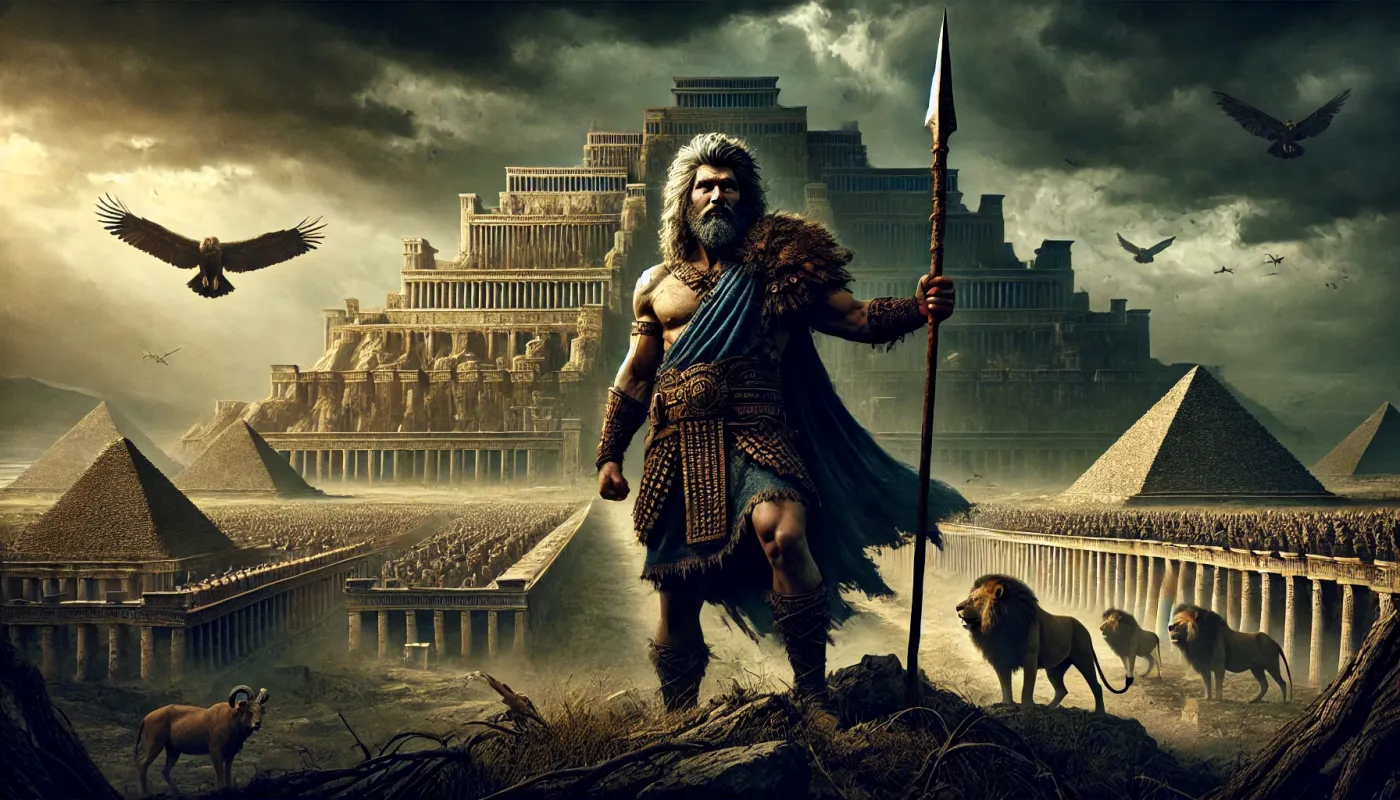
Many religious scholars and historians identify the biblical Nimrod with the Babylonian god Marduk. Nimrod was a deified historical figure who was previously regaled as “the great hunter” and founder of Babylonian cities such as Babel whereas Marduk became the chief god of Babylon especially as the city rose to power. This connection suggests Nimrod, son of Ham whose father was Cush making him a great grandson of Noah, was a powerful ruler and perhaps the first widely known king after the Great Flood. Some opine that Nimrod’s legend evolved from and/or into the ‘divine’ Marduk who was a uniquely brazen “rebel” against God’s order as well as the chief architect/builder of Babylon and the Tower of Babel.
Key Connections & Theories:
- Founder of Babylon: Nimrod is linked to building Babel (Babylon), and Marduk was the patron god and founder of Babylon, creating a strong parallel.
- Linguistic Links: Some suggest Nimrod’s name, derived from marad (“to rebel”), forms the root of Marduk (MRD) when vowels are dropped, indicating a shared identity.
- Deified Ruler: Ancient cultures often deified powerful rulers, and Nimrod’s role as a mighty hunter and king fits the pattern of transforming a historical figure into a god like Marduk.
- Shared Attributes: Both figures are associated with great power, perceived immortality, building major cities and fearsome hunting, further blending their identities.
- Syncretism: As Babylon grew, Marduk absorbed characteristics of older gods, making it plausible for him to incorporate the legend and biblical account of Nimrod.
In essence, Marduk serves as the Babylonian divine figure of Anunnaki lore who was also written about in the Book of Genesis as the biblical king Nimrod. In other words, they are one and the same personage, and both are notorious rebels against God. While Marduk rebelled against the ancestral reign of the god-king Anu of the Anunnaki ancient aliens, Nimrod rebelled against the so-called one true Hebrew god YAHWEH, who was the warring ancient alien military leader of the kingdoms of Israel and Judah as well as the ancient Semitic deity of Judaism.
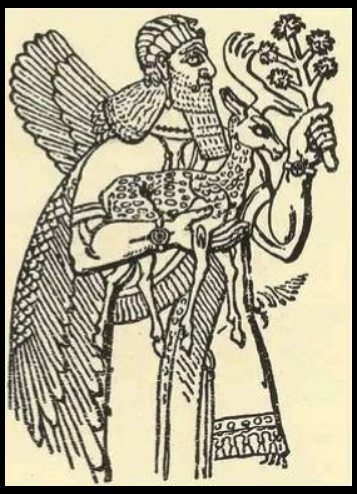
The deified Nimrod immortalized by his carrying an evergreen tree that never dies (now known as a Christmas tree) along with a deer (now a reindeer) on the other arm to symbolize his hunting prowess.
The symbols of Nimrod, the evergreen tree, and the deer are primarily connected through certain extra-biblical fables and specific interpretations linking them to the origins of Christmas traditions. These interpretations are popular in some Christian and alternative traditions but are not universally accepted historical or biblical facts.
Nimrod and the Evergreen Tree.
The connection between Nimrod and the evergreen tree comes from a Babylonian legend involving his mother/wife, Semiramis, after his death:
- The Dead Stump: According to this fable, Nimrod was “cut down” or killed (some accounts say by Shem, the son of Noah). The dead tree stump is said to symbolize the dead Nimrod.
- The New Tree: Semiramis propagated the belief that Nimrod was resurrected as a spirit being. She claimed a full-grown evergreen tree sprang miraculously overnight from the dead stump, symbolizing Nimrod’s new life.
- Gifts and Rebirth: Semiramis declared that on the anniversary of Nimrod’s birth (which she designated as December 25th, the winter solstice), he would visit the evergreen tree and leave gifts under it. This legend is presented as the origin of the Christmas tree and gift-giving traditions in works like The Two Babylons by Alexander Hislop.
Nimrod and the Deer
The association with the deer or fawn stems from ancient artistic interpretations or descriptions linked to the tree mythos:
- Ancient Depictions: Some proponents of this theory suggest that ancient drawings or depictions of Nimrod show him “wearing a long beard, carrying a spotted fawn or deer, and holding a fir tree in his hand,” which they see as precursors to the modern image of Santa Claus and his reindeer.
Overall Meaning
In these specific interpretations, the combined imagery represents a set of pagan religious practices and idol worship that allegedly predated Christianity and were later adopted into holiday traditions.
- The evergreen tree symbolizes the resurrected Nimrod (who was later conflated with other sun gods like Tammuz, Osiris, and Ba’al).
- The deer is seen as a part of the iconography associated with this figure in specific ancient art interpretations, linked to his identity as a “mighty hunter”.
- The entire narrative is used by some groups to argue against celebrating Christmas with these symbols, citing verses in the Bible like Jeremiah 10:3-4, which describes cutting and decorating a tree as a “doctrine of vanities”.
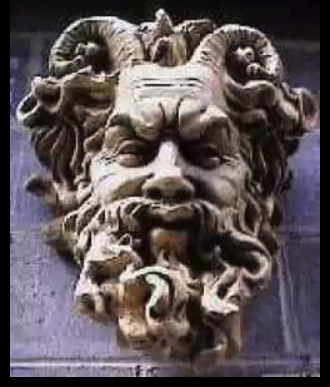
December 25th is Nimrod’s birthday. The rebellious king of Babel, who rose up to power with the mindset to kill the CREATOR in order for humanity to live an independently from HIM, and under his earthly rulership. The Tower of Babel was built as a massive temple testament in the form of a ziggeraut to Nimrod’s blasphemous mission.
Nimrod’s biological mother — Semiramis — who he actually married, planted a tree on top of his grave after he was buried, depicting the son’s spirit lives within the tree (and gravesite) indicating that he is not dead and she encouraged all devotees/subjects to merrily celebrate his rebirth and immortality day every year on December 25th.
That Babylonian belief system and pagan practice was eventually co-opted by the Roman Empire, practiced as a religious tradition of Christianity, and promoted by the Roman Catholic Church.
In point of fact, the Christmas tree and its various decorations are in fact a celebration is Nimrod and no other!
Posted by Michael Boateng
____
https://www.facebook.com/photo/?fbid=225623389012876&set=gm.3001110016811984